Pool Barriers
Pool Barrier Fixes, Ranked by What They Take
Sort pool barrier defects into afternoon adjustments, hardware swaps and structural work - each with the clause it satisfies, how to verify it, and what the fix can break elsewhere.
By Ray Vasquez · Published July 28, 2026 · Last checked July 28, 2026
On this page
- Sort by what the fix takes, not by how bad it sounds
- The afternoon list
- Hardware to buy, and how to specify it
- Structural work - and how to brief it
- The two fixes that quietly break something else
- Removable mesh, honestly
- The form your county hands you may be wrong
- Habits, which is where most barriers actually fail
- Frequently asked questions
If you walked your barrier using the checklist on the check that produces the defect list this page sorts and came away with a page full of suspected failures, this is where you turn that list into an order of operations. This page never re-derives the specification - it cites the individual requirement each remedy addresses, one at a time, and sends you back to that page for the full table.
Florida Building Code, Residential, 8th Edition (2023), chapter 45, R4501.17, effective December 31, 2023, and Fla. Stat. ch. 515, 2025 Florida Statutes, govern everything below. A 9th Edition exists in draft with no announced effective date. Your city or county may enforce a different edition or a local amendment. Checked for this page: July 28, 2026.
A number and its clause travel together in every line below, including the tables. And nothing here can leave you thinking a completed fix means your barrier has been found compliant - you can do the trivial work yourself, but you can’t certify the result, and neither can this page.
Sort by what the fix takes, not by how bad it sounds
An adjustment you can make and re-test this afternoon comes before a hardware purchase, which comes before rehanging a gate, which comes before structural work. That ordering isn’t about severity. It’s about what the fix actually takes, and the alarming-sounding defect is frequently the cheap one. Moving a patio chair away from the fence line costs nothing and removes a real failure - do the reversible things first, before you spend money on anything.
One thing needs saying plainly here, in this page’s own words rather than borrowed from anywhere else on this site: working through every item on the ladder below does not establish that your barrier complies with anything. The building department determines that. This page cannot, and neither can you, no matter how many boxes get checked off.
The ranked remediation ladder
Afternoon adjustments, no purchase required
- Gate closer tension and alignment (R4501.17.1.8) - re-test with five open-and-release cycles.
- Latch alignment, sighted along the gate’s top edge (R4501.17.1.8) - same five-cycle test.
- Clearing what’s stacked against the outside face (R4501.17.1.1; §515.29(5)) - re-measure height at that point. Flag: can interact with the height rule below.
- An overridden latch or keys left in an override (R4501.17.1.8) - remove the override, re-test the gate.
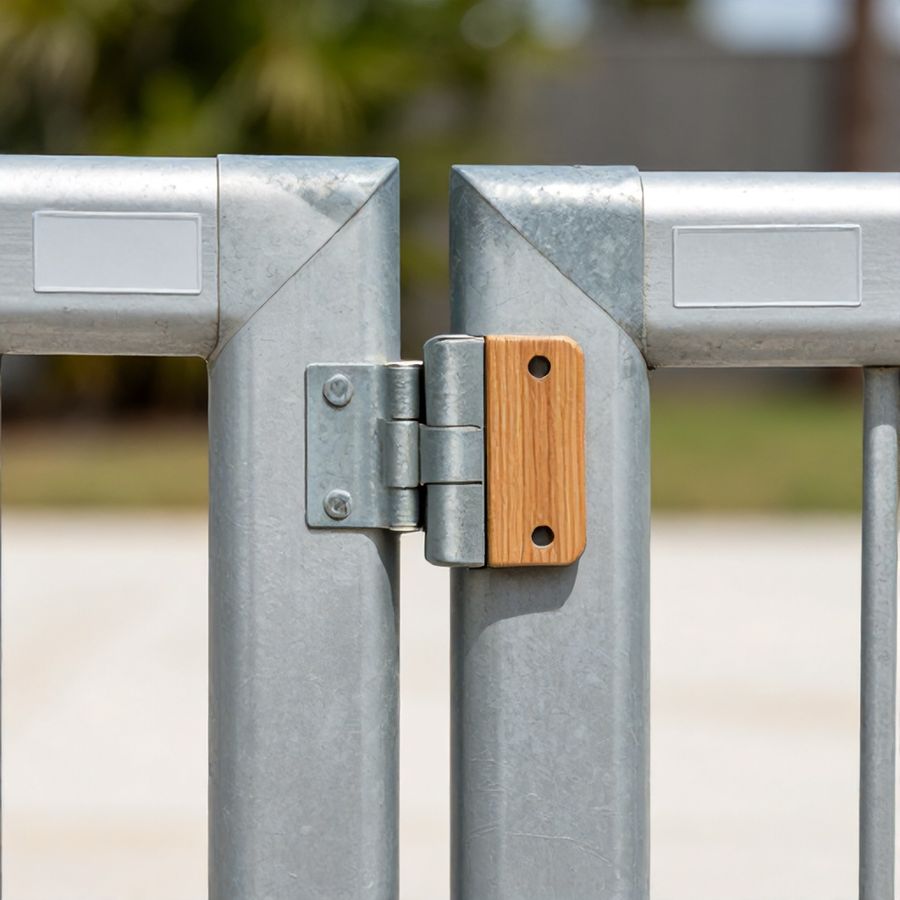
Hardware to specify and buy 5. Self-closing hinges and a self-latching device (R4501.17.1.8) - re-test with the five-cycle check. 6. Anti-sag cable, turnbuckle, or a heavier hinge set (R4501.17.1.8) - re-test alignment once tensioned. 7. Corrosion-appropriate hardware near the pool - re-inspect at the next service visit.
Structural work to brief a contractor on 8. Ground-line gap, closed with a physical barrier rather than fill (R4501.17.1.1) - flag: raising grade instead can cost you the height requirement, below. 9. Stepped or racked panel geometry (R4501.17.1.4, R4501.17.1.5). 10. Run replacement, where more than two independent requirements fail on one section.
The afternoon list
Start with the gate closer. If it drags, the cause is usually at the ground, not the hinge, and cranking up spring force to overcome scraping just treats the symptom. Here’s the one I’ll say plainly because I’ve seen it go wrong both ways: don’t back off a closer because the gate slams. If slamming is the real complaint, add a soft-close damper or a door stop - reducing tension removes the protection the closer exists to provide. Latch alignment is next, sighted along the gate’s top edge against the fence line; a stile that’s dropped even slightly throws the latch off by more than it looks like it should.
Then look at what’s leaning against the outside face. The movable list is long - patio chairs, coolers, planters, wheeled bins, firewood, toys and ride-on cars, a ladder left out after gutter work, stacked pavers, a leaned kayak, bags of soil. The fixed list is the one nobody puts away: the pump and filter pad, a heater, a salt cell enclosure, an air-conditioning condenser and its pad, an irrigation controller, a meter, a rain barrel, a generator, a storage box. Here’s why it matters more than it looks like it should: once any of those sits against the outside face, the barrier’s effective height gets measured from the top of it, permanently, not from the ground.
Last on the afternoon list: keys left in a latch override, or a magnetic latch left in the disabled position. Both defeat the self-latching requirement quietly, and both get fixed in under a minute once you notice them.
Hardware to buy, and how to specify it
Order self-closing hinges and a self-latching device that meets R4501.17.1.8, and know the two conditions vendors don’t lead with. The release has to sit on the pool side, unless it’s 54 inches (1372 mm) or more from the bottom of the gate. And no opening greater than ½ inch (12.7 mm) may exist within 18 inches (457 mm) of the release, on the gate and on the adjoining barrier both.
For a latch that keeps needing re-aiming, the principled fix is anti-sag cable and a turnbuckle running from the top hinge corner to the bottom latch corner, or a heavier hinge set, or a third hinge. A gate is a cantilever - its own weight racks the frame over time, and re-aiming the latch every few months treats the symptom, not the cause.
Then the corrosion point, which is a Tampa Bay point specifically. Chlorine and bromine vapor, the saline film off a salt-chlorine generator, and marine aerosol near the coast all seize springs, hinge pins, latch pins and set screws faster than inland hardware ever sees, and dissimilar metals fail galvanically against each other. Hardware selection near a pool is a corrosion decision as much as a mechanical one - buy for that environment, not the catalog photo.
Structural work - and how to brief it
The gap at ground level is the one homeowners try to fix themselves, and it’s usually the wrong fix. In sandy, high-water-table soil with intense seasonal rain, loose fill migrates and the gap reopens after every correction. The durable options are physical: a concrete or paver strip under the fence line, a buried kick plate or bottom rail set into the ground, or grade stabilization that redirects the water causing the washout in the first place.
Some problems aren’t workmanship at all. Stepped panels leave a triangular gap under the high end of each step. Racked panels change the effective vertical opening between pickets, even where the panel itself hasn’t failed. Neither shows up until you measure the actual opening rather than assuming the panel spec still applies.
On the replace-or-retrofit call: if a single run fails on more than two independent requirements, replacing that run is usually cleaner than stacking three separate retrofits on top of each other. That’s a judgment, though, not a rule, and it goes to a professional, not to an article. Nothing here amounts to directing unlicensed structural work - where a job requires moving the barrier, resetting a post, or adding a structural member, brief it to someone licensed and say so up front.
The two fixes that quietly break something else
This is the section I’d want a homeowner to read twice, because it’s where a synthesized answer gets people in trouble. Three interactions, each real, each documented in the same clauses you’re already working from.
First: raising grade to close a bottom gap loses effective height. The 2-inch (51 mm) ground clearance and the 48-inch (1219 mm) height are both measured on the side facing away from the pool, off the same surface - so closing the gap by raising that surface buys you clearance at the direct cost of height. Second: an infill panel added to close a spacing failure can create a foothold, turning a height compliance into a climbability failure that no tape measure will catch, because nothing about a foothold shows up as a dimension. Third: a latch relocated upward to clear the 54-inch reach threshold can open a gap inside the protected radius - the rule barring any opening greater than ½ inch within 18 inches of the release binds the barrier as well as the gate leaf, and Florida Building Commission Declaratory Statement DS2019-071 confirms it survives even where the release sits at 54 inches or higher.
The general rule these three share: on this structure, two requirements frequently share one surface, and a fix that moves the surface moves both of them. Re-check the neighbor every time you touch one.
Table: Defect, fix, and what else it touches
| What you found | The fix | What it satisfies | How to verify | Commonly breaks something else? |
|---|---|---|---|---|
| Gate drags or won’t self-close | Closer tension and alignment, not tension increase alone | R4501.17.1.8 | Five open-and-release cycles from three positions | No |
| Gate closes but doesn’t latch | Anti-sag cable, heavier hinge, or gusseted frame | R4501.17.1.8 | Five-cycle latch test | No |
| Bottom gap over 2 inches | Concrete or paver strip, buried kick plate, or grade stabilization | R4501.17.1.1 | Re-measure gap and height together | Yes - raising grade instead trades height for clearance |
| Wide spacing closed with an infill panel | Infill sized to spacing limits, checked for footholds | R4501.17.1.4, R4501.17.1.5 | Re-check spacing and climbability together | Yes - can create a climbing foothold |
| Latch moved to clear the reach rule | Reposition and re-check the 18-inch radius | R4501.17.1.8; DS2019-071 | Measure openings within 18 inches after any latch move | Yes - can reopen the protected-radius rule |
| Stepped or racked panel | Corrected panel geometry, re-measured on site | R4501.17.1.4, R4501.17.1.5 | Measure actual opening, not nominal spec | No |
| Something stacked against the outside face | Remove it; treat as permanent if it can’t be | R4501.17.1.1 | Re-measure height at that point | No |
| Mesh section sagging or bottom scalloping | Manufacturer-specified retensioning or pole reseating | R4501.17.1.15 | Visual check plus the ground-line and gate tests | No |
Removable mesh, honestly
The code side first. A mesh safety barrier that follows the manufacturer’s instructions and meets ASTM F2286 counts as a barrier under R4501.17.1.15. A hinged gate built into a mesh run has to satisfy R4501.17.1.8 in full, including swing direction and the latch rules. Mesh may not be installed on top of an above-ground or on-ground pool. And one end of any removable barrier, mesh included, must not be removable without tools (R4501.17.1.2, repeated at R4501.17.1.11).
Table: Barrier types under the code
| Type | Does the code address it explicitly | Clause | Conditions attached | Restrictions |
|---|---|---|---|---|
| Permanent fence | Yes | R4501.17.1.1-.1.8 | Full specification applies | None beyond the specification |
| Screen enclosure | Yes | R4501.17.1.11 | Counts as a non-dwelling wall only if every other requirement is met | Does not relieve a dwelling wall’s door/window obligations |
| Removable mesh | Yes | R4501.17.1.15 | Manufacturer’s instructions plus ASTM F2286 | Not on top of an above-ground or on-ground pool |
| Dwelling wall with openings | Yes | R4501.17.1.9 | Requires an exit alarm, self-closing door, or pool alarm on each opening | Statute grants no window exceptions |
| Above-ground pool wall | Yes | R4501.17.1.1, R4501.17.1.10 | Wall itself must clear 48 inches; ladder must be securable, lockable, or removable | Same sphere test applies to any resulting opening |
| Safety cover | Yes, as the code’s one exception | R4501.17 exception; ASTM F1346 | Approved cover in place | Contents of ASTM F1346 not stated here |
| Adjacent waterway | Yes | R4501.17.1.14.1 | Only when approved by the authority having jurisdiction | Discretionary, never assume it |
Now the honest negative, and it’s more useful than any number could be. No independent service life exists for removable mesh. Three research routes turned up zero non-vendor sources, and the figures in circulation - five to ten years, fifteen to twenty years, a “100-year warranty,” “lifetime” - contradict each other by a factor of four, and every one of them originates with a seller. A “ten to fifteen years” figure that shows up in some of the material describes screen-enclosure screening, a different product entirely, and it doesn’t transfer to mesh pool barriers.
The failure modes worth knowing are structural to the product itself: tension loss, a bottom edge that scallops between poles, poles working loose in their sleeves, missing sleeve caps, an overlap opening where a self-closing gate section should be. And above all, removability - a section taken down for a pool service visit or a party and not reinstalled leaves a household believing they have a barrier because they own one.
The form your county hands you may be wrong
I’m putting this here rather than earlier, because the reader most likely to be handed this form is the one already dealing with a defect. The Pinellas County pool and hot tub form, retrieved live on July 28, 2026, and still linked as current from the county’s own service page, carries four checkable problems. It cites “Chapter 315” of the Florida Statutes, which is Port Facilities, not pool safety - and the county’s own web page repeats the same error, while the form’s own penalty paragraph correctly cites chapter 515. It lists four compliance methods where §515.27(1) lists five; the missing one is the ASTM F2208 in-water pool alarm. It’s statute-only and never mentions the Florida Building Code at all, while neighboring municipal forms cite the 8th Edition explicitly - and because chapter 515 reads as a five-way menu while R4501.17 does not, a form built only on the statute understates what the code actually requires. And it names “ASTM F1346-91” with no printed revision line; the only datable evidence is a server “last modified” stamp of October 22, 2022, more than a year before the 8th Edition took effect.
I’m writing this as a dated, checkable fact about a current document, not as an attack on the county - forms go stale everywhere, and this one did. The practical instruction is simple: work from the code section itself, and ask the department which edition it assesses against before you assume the form in your hand is current.
Pasco’s own zoning layer is worth one sentence here, because it constrains which remedies are available in that county specifically: LDC §530.4(D) sets a barrier at least four feet high with no opening greater than four inches, and names no alarm option anywhere in the section. The full treatment of that ordinance lives on the sibling page.
Habits, which is where most barriers actually fail
The service visit is a systematic barrier-opening event, and it’s worth treating as a real constraint rather than an oversight. The technician needs access, opens the gate or lifts a section, and works on a schedule that rarely lines up with the family being home - so a household with a removable barrier or a locked gate needs an explicit protocol with the provider, and a way to verify reinstatement afterward, not just an assumption that it happened.
Guests and short-term rentals bring a different risk. Nobody visiting has the habit memory a homeowner builds over years, and a propped gate reads to them as a convenience, not a hazard. Construction and commissioning carry their own exposure: a shell holding rainwater, a pool filled before the permanent barrier goes up, contractor traffic in and out, temporary fencing moved daily - risk peaks exactly when the household’s safety habits don’t exist yet. Storm recovery adds a fourth: sections down, debris stacked against fence lines, temporary panels and tarps, gates left open, water gone opaque, sometimes for weeks at a stretch.
The pattern across all four: the commonest failure isn’t a badly built barrier. It’s a correctly built one that has moved. That’s why a recurring check beats original installation quality every time.
Verification test card
| Fix | The test | What a pass looks like | Repetitions |
|---|---|---|---|
| Gate closer and latch | Open to half, wide-open, and barely ajar; let go completely each time | Closes and latches with no hand and no push | Five, from three starting positions |
| Ground-line gap | Walk the outside face, measuring the largest gap on the run | 2 inches or less, on the side facing away from the pool | Once per section, every re-check |
| Reach and release | Measure any opening within 18 inches of the latch release | No opening greater than ½ inch | Once per gate |
| Climbable objects | Sweep the outside face for anything stackable or fixed against it | Nothing placed against the barrier at any height | Every visual re-check |
The footer line on this card is fixed, and it’s the same ceiling as everywhere else on this page: completing it establishes that no failures were found by these checks. Nothing more. It doesn’t establish compliance, and only the building department makes that determination.
Frequently asked questions
My gate closes but does not latch. Hinge or gate? Usually the gate - it’s a cantilever, and its own weight racks the frame until the latch-side stile drops. Sight along the top edge, then fix with anti-sag cable, a heavier hinge, or a gusseted frame rather than re-aiming the latch. Don’t increase spring tension to overcome drag.
Can I just fill in the gap under the fence? Not with loose material - sandy soil, a high water table, and seasonal rain migrate the fill, and the gap reopens. Use a concrete or paver strip, a buried kick plate, or grade stabilization instead. Watch the trade-off: raising the ground closes the gap but costs you height, since both are measured from the same surface.
Do I have to replace the whole fence? Usually not. Hardware-level fixes are the cheapest interventions in the system and often close the live defect alone. The honest threshold: more than two independent failures on one run usually makes replacement cleaner than stacking retrofits, and that call goes to a professional.
How long does a mesh pool fence last? Nobody independent has published a figure. The numbers in circulation vary by a factor of four and all come from sellers. What’s verifiable is what the code requires of mesh, and the failure modes, tension loss, scalloping, loose poles, that are structural to the product itself.
The county gave me a form. Do I just follow it? Use it for the paperwork, but work the actual requirements from the code section. This page documents four defects in Pinellas’s own form, dated. Ask the department which edition it assesses against first.
How do I know the fix actually worked? Re-test with the specific test for that fix, then re-check whatever shares a surface with it. That confirms the check passed, not that the barrier complies - only the building department determines that.
Do the afternoon list today and re-test it before you buy anything. Then brief the rest in writing, with the clause beside each item.
For the head-to-head this page’s table deliberately doesn’t give, see the comparison layer’s mesh-versus-permanent coverage. For any money question, the costs cluster covers it. And where a city page exists, it recaps what’s local to that address. Start from the check that produces the defect list this page sorts, or what a fence project involves in this metro from the homepage.
Sources
| Claim | Primary source | As of |
|---|---|---|
| Every code clause a remedy cites | Florida Building Code, Residential, 8th Edition (2023), chapter 45, R4501.17 (ICC Digital Codes) | 8th edition, effective December 31, 2023; re-sourced July 28, 2026 |
| The half-inch-within-18-inches rule survives a 54-inch release | Florida Building Commission Declaratory Statement DS2019-071 | Clause text unchanged in the 8th edition |
| Gate swing; the statute’s release rule | Fla. Stat. §515.29(3) | 2025 Florida Statutes |
| The five statutory methods, against the form’s four | Fla. Stat. §515.27(1) | 2025 Florida Statutes |
| The four defects in the county form | Pinellas County pool/hot tub form | Retrieved live July 28, 2026; server last-modified October 22, 2022 |
| Pasco’s zoning layer | Pasco County LDC §530.4(D), Supplement 20 Update 1, codified through Ord. 26-22 | June 16, 2026 |
| Standard designations only, contents not read or stated | ASTM F2286-16(2023); ASTM F1346-23; ASTM F2208-08(2025); ANSI/UL 2017 Ed. 2, revised January 17, 2024 | Retrieved July 28, 2026 |
| No independent mesh service life exists | Three targeted research routes, zero non-vendor sources | Searched July 28, 2026; published as a dated negative |
Code text last checked: July 28, 2026.
This page sorts remediation; it does not determine compliance. Only your county or municipal building department can make that call, and nothing here amounts to directing unlicensed structural work - where a job requires the barrier to move, a post to be reset, or a structural member added, brief it to a licensed professional. A barrier is one layer of pool safety, not the whole system, and no completed fix on this page implies otherwise. This is an independent information site: it installs no fences, employs no crews, holds no contractor license, performs no inspections, and cannot certify that any barrier complies with any code or statute.
Code citations and remediation requirements reviewed by Dana Whitfield, CGC, certified building code inspector.


Code and permit claims reviewed by Dana Whitfield, CGC, certified building code inspector.
Florida-licensed general contractor, certified building code inspector. How we check facts: our sources and limits.
Read next
- Florida Pool Barrier Code: Every RequirementWhat the Florida pool barrier rules require, clause by clause, with the code section and the surface each measurement is taken from - plus a walk-round check for your own barrier.
Want a quote read by someone who has no stake in it?
We do not install fences. Tell us what you are planning and we pass the request to a licensed contractor who works your area.
Request a callback
Enter your number and we will call you back. Nothing else is required.
We do not install fences. Your request goes to a licensed contractor who works your area, and we may be compensated for the introduction.
Advertiser disclosure. This page can earn us money. If your request reaches a contractor through the form or the phone number above, we may be compensated for that introduction. It has never determined what any page on this site says, and no contractor has editorial input. We hold no contractor licence of our own and perform no work.