Fence Materials for Tampa Bay: What Each One Costs, and How Long It Really Lasts
Wood, vinyl, aluminum, chain link and composite compared on price, service life and what this climate does to them, with every figure carrying the source it came from. We sell none of them and install none of them.
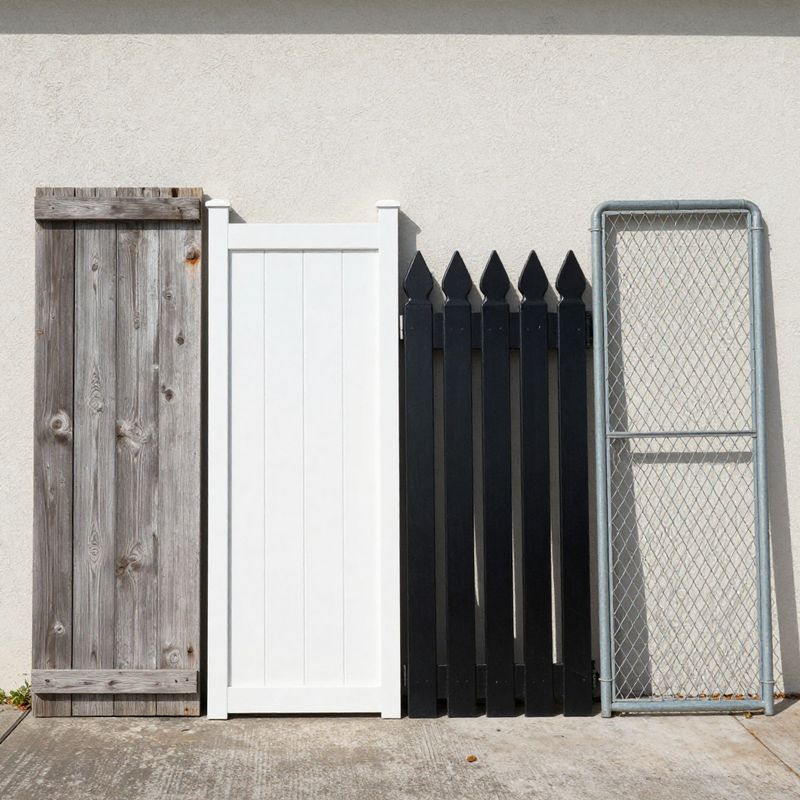
How this hub compares materials, and what "better" is allowed to mean
There is an uncomfortable fact behind every fence material comparison on the internet, and stating it up front is the most useful thing this page does. Almost none of the service-life, warranty or degradation numbers in this category come from an official body, a standards organization or an independent test. They come from manufacturers and installers.
We looked for something better across every material in this hub and did not find it.
That does not make the figures useless. It makes them directional. A vinyl manufacturer claiming twenty to thirty years is telling you roughly where the material sits relative to wood, and several independent sellers landing in the same region is worth something.
What it is not is a measurement you can plan a budget around to the year, and any page presenting it as one has either not checked or is counting on you not to.
So the rule here is simple. Every number below carries what it is: a band, a source class and the month it was gathered. Prices come verbatim from this site's own Tampa Bay cost research rather than being recalculated on a comparison page, because a figure that gets re-derived twice stops being traceable.
Where a material has no local figure, we say that instead of substituting a national one and hoping you do not notice. Ray Vasquez spent twenty-two years quoting these materials in this metro and four more as an estimator, and that experience shapes the judgment calls in the verdicts. It is not a laboratory and nothing here was tested by us.
The whole field on one screen
Installed cost per linear foot, Tampa Bay, gathered July 2026. Service life is what sellers and installers publish, and the spread is shown rather than averaged.
| Material | Installed, per linear foot | Published service life | What ends it here | Upkeep |
|---|---|---|---|---|
| Chain link, galvanized | $12-20 | Commonly 15-20 years; sources range 10-25, one says up to 30 | Salt air consumes the sacrificial zinc faster than inland exposure does | Effectively none |
| Chain link, vinyl-coated | Within the same band | Claimed 20-30+ | The coating protects the zinc beneath it | Effectively none |
| Wood privacy, treated pine | $18-32 | The least consistent number on this site: 5-10 years in hot humid climates from one aggregator, 10-20 from others, 15-20 for premium species, one source says 15-40. Cedar 15-25 | Fungal decay at the ground-contact base of the post, almost always first | Stain or seal every 2-3 years, some sources say 2-5 |
| Vinyl privacy (PVC) | $25-40 | Commonly 20-30, some sellers 25-35 | UV photodegradation: fading, chalking, gradual embrittlement | Washing |
| Aluminum ornamental | $28-45 | Commonly 30-50+ | Galvanic corrosion where dissimilar-metal fasteners meet the frame | Effectively none |
| Composite | No Tampa Bay figure exists. Florida proxy around $70 | Not established locally | Not established locally | Low |
| Wrought iron and steel look-alikes | No measured metro price. See below | Varies with the actual base metal, which is often not iron | Rust, on the genuine steel products | Repainting |
Two rows in that table are honest gaps rather than data, and both are worth a paragraph.
Composite has no Tampa Bay price in any source we checked, across two separate passes. Two genuine Tampa contractors publish rates for the other four materials and carry no composite line at all, which suggests it is simply not commonly quoted here.
Advertised Tampa-tagged figures do exist at $40-70 standard and $70-100+ premium, and a directory shows "from $45 per foot", all somewhat below the Florida statewide proxy we use. The proxy stays labeled as a proxy in every place it appears, including inside the estimator.
Two local contractors pricing four materials and skipping the fifth proves nothing on its own, but it is the kind of silence worth noticing before you build a budget around a material nobody here quotes.
Wrought iron has a naming problem before it has a price problem. Nearly everything sold as a wrought iron fence today is mild steel, often tubular, powder-coated in a traditional pattern. True wrought iron has essentially ceased commercial production.
Buyers routinely treat "aluminum ornamental" and "wrought-iron-style steel" as interchangeable when they differ in base metal, corrosion behavior, weight and price.
And the prices, when you gather them, refuse to converge: ProMatcher put Tampa at $20-26 per foot in 2021, homeyou at $20-100 in 2026, a cross-market figure sits at $35-65, a Tampa directory advertises "from $38", and Yelp separates modern look-alikes at $25-55 from hand-forged work at $300-500.
We publish that spread with each figure's source, date and scope and we do not average it, because an average of five irreconcilable numbers is fake precision. The estimator does not offer the material at all for the same reason.
What this climate actually does to each material
Five mechanisms explain nearly every failure in the table above, and knowing them is more durable than memorizing anyone's warranty length.
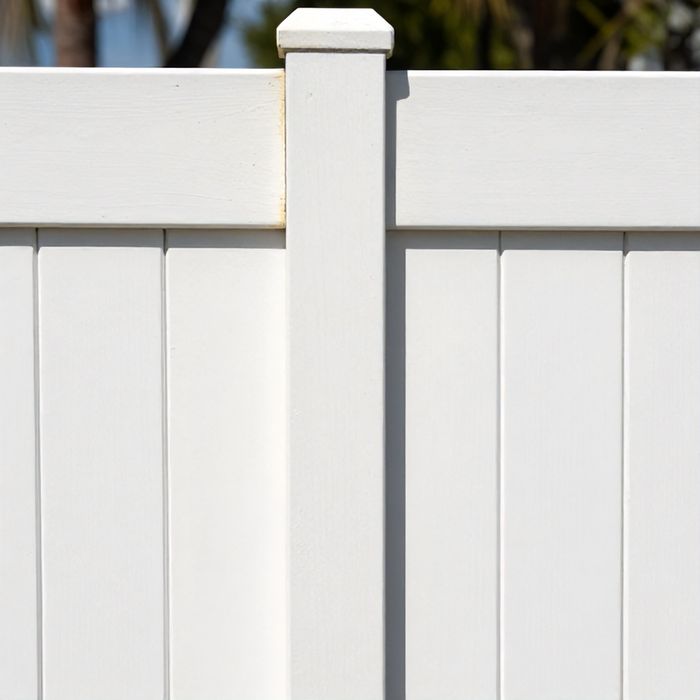
Vinyl chalks because of ultraviolet light, not heat. Continuous sun breaks down the surface polymer chains of rigid PVC, producing fading, a powdery residue and slow embrittlement. Titanium dioxide and other stabilizer packages blended into the compound slow it; formulations without them, often lower grade or recycled content, chalk and yellow sooner.
Darker colors absorb more radiation and go first.
Heat on its own rarely kills vinyl, but heat plus continued UV reduces impact resistance over the years, so an older panel cracks under a storm impact that a new one would have shrugged off even when it still looks fine.
No Florida-specific timeline for chalking onset exists anywhere in our research, so we describe the mechanism and refuse to name a year.
Galvanized steel survives by sacrificing its zinc. The coating is more anodic than the steel beneath it, so it corrodes preferentially and protects the base metal even at small breaks in the coating, until the zinc is consumed. Salt-laden humid air accelerates that consumption relative to drier inland exposure.
That is the entire reason a chain link fence three blocks from the water behaves differently from the same fence in Wesley Chapel, and it is why vinyl-coated fabric earns its premium near the coast.
Aluminum does not rust, and that is not the same as being immune. Galvanic corrosion occurs when two dissimilar metals are in electrical contact with an electrolyte present, and salt-laden moisture is a very effective electrolyte. The less noble metal goes first.
Plain steel fasteners against an aluminum frame corrode at the contact point. Match the fastener metal to the frame or isolate it, and ask for salt-spray-chamber evidence rather than accepting a marine-grade sticker. Nobody has quantified what any of this does to service life in this specific metro.
Wood fails at the bottom of the post, from fungi rather than from age. Wood-rot fungi need sustained moisture, oxygen and warmth to metabolize cellulose, and the ground-contact base of a post holds moisture longer than anything else in the run. Termites are a second, related problem: they prefer soft, moist, fungus-affected wood, and most infestations start where wood touches or nearly touches soil.
UF/IFAS names fence posts among pressure-treated wood's typical uses, lists attached fences among the wood-to-ground-contact pathways that bring termites toward a house, and states plainly that treatment offers no guarantee of permanent protection.
One Florida-specific consumer point deserves its own sentence, and it is from UF/IFAS rather than from us: Florida permits pest control companies to exclude Formosan and Asian subterranean termites from contract warranties.
Read the contract you are signing.
The cheapest material is not available everywhere
This is the finding that most surprised us, and it belongs beside price rather than in a footnote, because it can remove an option before the budget conversation starts.
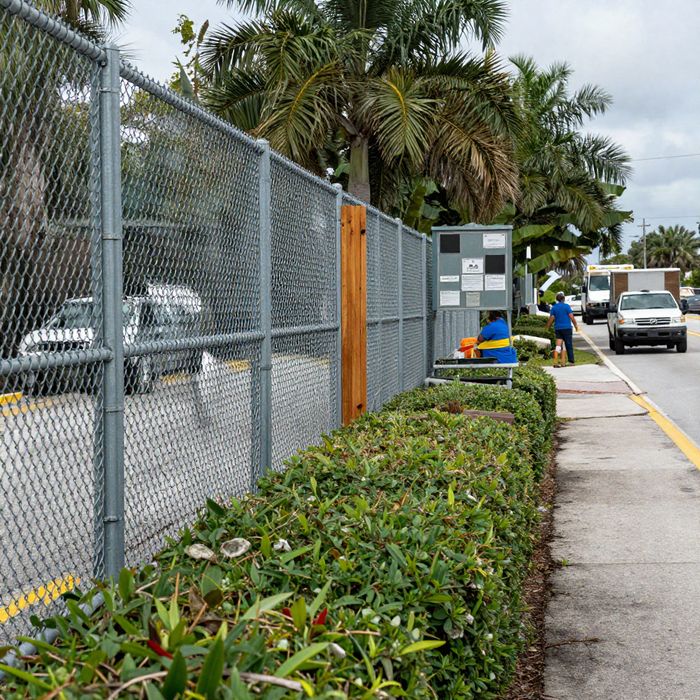
Pasco County prohibits chain link, welded wire and similar fences and gates where they are visible from a collector or arterial roadway, unless the property is zoned industrial. That is county-wide, from Land Development Code section 1003.1.G, adopted by Ordinance 24-45 on 12 November 2024 and codified through Ordinance 26-22 of 16 June 2026.
Clearwater goes further and regulates chain link as its own separate class under Community Development Code section 3-805, Supplement 55, codified through Ordinance 9857-25 of 4 December 2025.
It is prohibited in the Downtown District, prohibited in front of the principal structure, capped at 48 inches unless clad in green or black vinyl, in which case six feet, prohibited where a side or rear lot line abuts a public right-of-way, and required to be landscaped with a continuous hedge or vine.
So in Clearwater the cheapest material comes with a landscaping bill attached, and the city's own code treats vinyl-clad more permissively than bare, which happens to agree with what salt air already recommends.
Neither rule is a building code question and neither goes through a building department. They are zoning, with a different office behind them. The height and setback article carries the measurement conventions and the rest of the local dimensional picture.
Total cost of ownership, now that one gap has partly closed
The wood-versus-vinyl argument has always been about whether a cheaper install stays cheaper, and until recently we could not price the maintenance half of it at all.
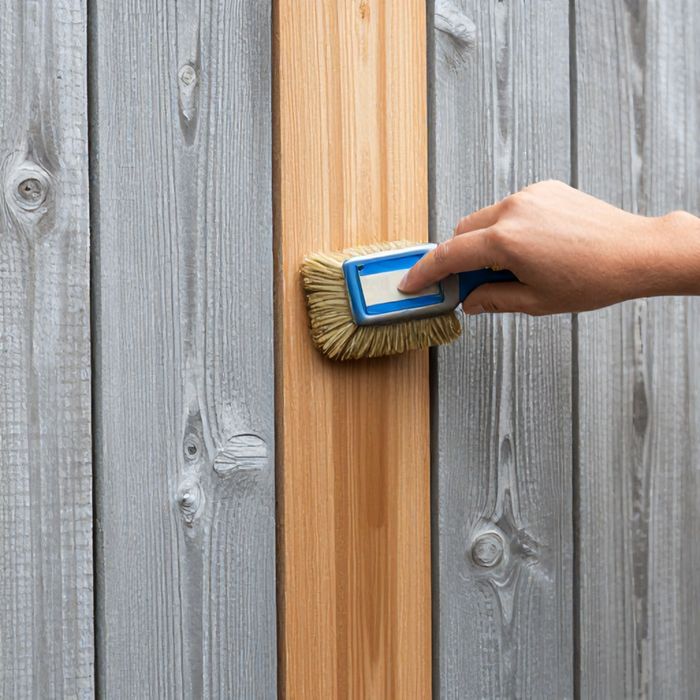
A dated Florida figure now exists: staining or sealing a wood fence runs $1.50 to $4.00 per linear foot in Jacksonville, advertised, 2026. That corroborates a cross-market $1 to $3 per foot already on file.
No Tampa Bay figure exists after three separate attempts, which is a confirmed absence rather than a gap in effort, and an AI-generated answer claiming a Tampa Bay figure traced back to a source that never claimed that geography.
We publish the Florida number labeled Florida.
Set against a reapplication interval that most sources cluster at two to three years, that is enough to make the comparison concrete for the first time. A 150-foot wood run at the Florida rate implies a few hundred dollars per cycle, against a vinyl run that needs washing.
Over fifteen years the arithmetic can invert the ranking that the install quote suggested, which is the entire argument of the wood versus vinyl comparison and the reason it exists as a page.
One more upkeep-adjacent number, because it is the only construction adder on file in this hub: board-on-board costs $6 to $10 per foot above base wood privacy. Shadowbox has no local adder on record at all, and that asymmetry is stated rather than smoothed over.
Which comparison should you open?
- You want full privacy and you are weighing two low-maintenance premium materials. Start at vinyl against aluminum. It carries vinyl's full property profile, which the other vinyl pages recap in a sentence, and it resolves the wrought-iron naming question.
- You are choosing between paying less now and paying less over ten years. Wood against vinyl is the total-cost-of-ownership page, and the one where the service-life spread is widest and most honestly reported.
- Budget is the constraint and you mainly need containment. Chain link against vinyl, which also carries the two municipal restrictions above and what they mean for your parcel.
- Wood is already decided and the question is the pattern. Shadowbox against board-on-board, where the wind performance question turns out to be genuinely unresolved between Florida installers and out-of-state ones, and we publish it as a conflict rather than picking the side we like.
- The fence is going around a pool. Removable mesh against a permanent barrier compares the two as products only. Every legal question about pool barriers, every dimension and every clause lives in the Safety Act requirements article, and a product decision taken without reading that one is a decision taken blind.
Mesh deserves a warning that sits here as well as there. Searching three separate ways, including searches restricted to CPSC, PoolSafely, NFPA, NIST and university sources, produced no non-vendor service-life figure of any kind. Every number in circulation, from five to ten years up to a hundred-year warranty, originates with a seller, and they disagree with each other by a factor of four.
Some sellers contradict themselves on their own pages about whether the weave obstructs the view. That is more useful to know than any of the numbers.
Everything in this hub
Material comparisons
- Vinyl vs Aluminum Fence: And Is That "Wrought Iron"?two premium low-maintenance materials whose price bands overlap, so the decision is openness against privacy rather than cost. Resolves what "wrought iron" actually means on a modern quote.
- Wood vs Vinyl Fence: Upfront Price vs Upkeepthe total-cost-of-ownership comparison, with wood's service life published as the wide conflicted spread it genuinely is.
- Chain Link vs Vinyl: Cheapest Fence, and Its Catchthe cheapest band on the site against a finished look, plus the two jurisdictions where chain link is restricted before price is even discussed.
- Shadowbox vs Board-on-Board: Privacy, Airflow, Winda wood construction pattern choice where the Florida wind claim is unresolved and both sides are shown with their evidentiary weakness.
- Mesh vs Permanent Pool Barrier: The Product Questiona product comparison on cost, sightlines, durability and daily use. The law is owned entirely by the pool barrier cluster and pointed to, never restated here.
Tools built from the same numbers
- Fence Cost Estimator for Tampa Baymaterial, height, perimeter, corner count, gates, terrain and removal, returning a low and a high with every rate constant printed on the page, dated and sourced. No email required.
- Deferred-Interest Calculator: What It Costs If You Missenter the terms from your own financing offer and see the retroactive charge if a balance remains when the promotional window closes. This site publishes no rates of its own and never will.
Questions this hub answers
Which fence material lasts longest in Florida?
On published figures, aluminum ornamental sits highest at 30 to 50 years and more, with vinyl behind it and wood lowest and least consistent.
Why does this site refuse to give one price for wrought iron?
Because the metro has no measured price for it. Five sources spanning 2021 to 2026 give figures from $20 to $500 per foot, some as ranges and some as starting prices, and part of the spread is a naming problem rather than a pricing one. Averaging them would produce a number that looks authoritative and describes nothing.
Is vinyl-coated chain link worth the premium near the water?
The corrosion mechanism says yes: the coating shields the sacrificial zinc that salt air consumes. Clearwater's code effectively agrees, treating vinyl-clad chain link more permissively than bare. What nobody has published is a Tampa Bay timeline putting a number on the difference, so treat it as a well-supported direction rather than a calculated payback.
Can I use these numbers to check a quote I already have?
That is what they are for. Put your yard through the estimator, which uses the same bands with every constant visible and dated, then read the quote-reading guidance in the cost cluster. Two things the estimator deliberately does not price are the permit fee and any architectural review fee, because it has no way of knowing which authority governs your parcel.
Does Tampa Bay Fence Co. sell or install any of these materials?
No. We do not install fences, employ crews or hold a contractor license, and no material on this page is one we have a commercial interest in your choosing. Where a page connects you with a contractor, it says so on the page.
This page compares fence materials on published figures and physical mechanisms. It is general information, not construction advice, and it is not a product recommendation for your property. Tampa Bay Fence Co. does not install or sell fencing, employs no crews and holds no contractor license. Service-life, warranty and degradation figures in this category come from manufacturers and installers rather than from any independent or official body, and we label them that way rather than implying an authority they do not have. Prices are ranges gathered in July 2026 and they move. Municipal material restrictions differ between one jurisdiction and the next; confirm yours with the office named on your city's page. Where a page connects you with a contractor, we may be compensated, and that never decides what a page says.
Code and safety claims on this page reviewed by Dana Whitfield, CGC, certified building code inspector.
Want a quote read by someone who has no stake in it?
We do not install fences. Tell us what you are planning and we pass the request to a licensed contractor who works your area.
Request a callback
Enter your number and we will call you back. Nothing else is required.
We do not install fences. Your request goes to a licensed contractor who works your area, and we may be compensated for the introduction.
Advertiser disclosure. This page can earn us money. If your request reaches a contractor through the form or the phone number above, we may be compensated for that introduction. It has never determined what any page on this site says, and no contractor has editorial input. We hold no contractor licence of our own and perform no work.