Materials
Chain Link vs Vinyl: Cheapest Fence, and Its Catch
What chain link saves, what it costs you in privacy and acceptance, why coated beats bare near the coast - and the two jurisdictions here that restrict it outright.
By Ray Vasquez · Published July 28, 2026 · Last checked July 28, 2026
On this page
Chain link costs less than anything else on this site, and that’s not a marketing line, it’s what the numbers say. If you’re weighing that number against six-foot vinyl privacy panels, you’re really asking two questions at once: can you live with how little privacy chain link gives you, and will anyone actually let you put it up. I’ve quoted both more times than I can count, from a commercial job in Brandon early in my career to backyard runs in Riverview and Land O’Lakes later on, and the second question trips up more homeowners than the first.
This page is one entry in a wider comparison of fence materials across Hillsborough, Pinellas and Pasco, where I try to lay out how we compare fence materials without selling one rather than pushing whichever one pays best. Read the hub first if you haven’t settled on a material family yet; this page assumes you’ve already narrowed it down to these two.
How we compared them
I picked criteria that isolate the trade-off that actually defines this pair: budget and security on one side, privacy and curb appeal on the other. Maintenance and installation speed matter less here than they do on other comparisons, because nobody chooses between chain link and vinyl over how fast a crew works. I also folded in a coastal sub-recommendation, since salt air off the bay is a real factor here even where nobody has put a hard number on it for this specific pairing.
The cost figures below come straight from this site’s own pricing research, reused verbatim rather than re-estimated for this page. I didn’t run physical tests on either material; nothing here claims lab verification of anything.
One correction belongs here rather than buried in a footnote. A lot of chain-link marketing cites ASTM F2408 as the fabric standard. It isn’t. F2408 covers ornamental galvanized steel tube fencing, a different product entirely. The designation that actually governs woven chain-link fabric is ASTM F567-14a (Reapproved 2019). You’ll also see “F567-23” referenced online; I traced that one back to an unconfirmed, paywalled reseller page and left it out of this comparison. The chain-link standards are a family of documents, not a single one, and what follows names designations - it doesn’t tell you what any of them requires.
The comparison
| Criterion | Chain link | Vinyl | How solid is this claim |
|---|---|---|---|
| Installed cost class | $12-20/lf at 4-6 ft, the cheapest band on this site | $18-28/lf picket, $22-36/lf semi-privacy, $25-40/lf privacy (6 ft) | Reused verbatim from this site’s own cost research |
| Privacy and sightline | Minimal; open weave, full sightline through | Picket to full privacy depending on style chosen | Consistent across sources |
| Security and height options | Up to 12 ft in commercial/security settings; barbed wire, razor ribbon or a bottom tension wire can be added | No equivalent height range or security augmentation | Consistent, once residential and commercial contexts are separated |
| Published service-life range | Commonly cited at 15-20 years; sources range 10-25, some say up to 30 depending on environment and upkeep | Roughly 20-35 years across the sources in this set | Commercial and hedged; one source is internally inconsistent on its own page |
| Coastal degradation | Zinc coating corrodes first to protect the steel; salt air is understood to speed that up versus inland exposure | Not zinc-dependent; the coating shields the core generally | Mechanism agreed; no Tampa Bay-specific timeline exists for either option |
| Maintenance | Low; no painting needed | Low but not zero; periodic washing against mold and mildew | Consistent |
| HOA and aesthetic acceptance | Often restricted or discouraged on curb-appeal grounds | Generally accepted for residential privacy use | Single-source pattern on the chain-link row, not a verified universal rule |
| Installation speed | Posts set in concrete, fabric stretched and attached | Each panel individually measured, leveled and secured | Consistent |
The table carries the weight, but here’s what it can’t show in a cell: chain link is the least expensive band on this whole site, running $12-20 a linear foot installed at 4-6 feet. Vinyl doesn’t give you one number to set against that. Picket-style vinyl runs $18-28 a foot, semi-privacy $22-36, and full privacy at six feet $25-40. This isn’t one price against one price. It’s a single budget band on one side against a family of styles on the other, and which vinyl style you actually mean changes the size of the gap considerably. Pick picket-style vinyl and the difference is real but modest. Pick six-foot privacy panels and it roughly doubles.
Before you price it: where chain link is restricted
Here’s the part that belongs before the price tag, not after it, because in two of the three counties I work in, it can end the conversation before a quote is even written up.
Pasco County’s Land Development Code, §1003.1.G, prohibits chain link, welded wire or similar fencing and gates that are visible from a collector or arterial roadway, county-wide, unless the property is zoned industrial. That’s not a design preference. It’s a flat prohibition tied to road classification: a quiet cul-de-sac that happens to back onto a busier road falls under it just the same as a lot that fronts one directly. The section traces to Ordinance 24-45 (November 12, 2024), carried through Supplement 20 Update 1 and codified through Ordinance 26-22 (June 16, 2026).
Clearwater regulates chain link even more specifically. Under CDC §3-805, it’s a separately regulated class of fencing entirely: prohibited outright in the Downtown District, prohibited in front of a lot’s principal structure, capped at 48 inches unless clad in green or black vinyl (which allows 6 feet), and prohibited anywhere a side or rear lot line abuts a public right-of-way. Whatever chain link the city does permit also has to be screened with a continuous hedge or vine planting. That comes from Supplement 55, codified through Ordinance 9857-25 (December 4, 2025).
Two consequences follow, and both belong in the verdict, not the fine print. First, the cheapest material on this site can carry a landscaping bill in Clearwater, which is exactly the hidden total-cost item this comparison exists to surface. Second, Clearwater’s own code treats vinyl-coated chain link more favorably than bare galvanized, which lines up with the coastal recommendation two sections down from a completely separate direction. The city isn’t thinking about corrosion when it wrote that rule. It landed on the same answer anyway.
| Jurisdiction | What’s restricted | Section | Supplement and codification date |
|---|---|---|---|
| Pasco County | Chain link, welded wire or similar fencing and gates visible from a collector or arterial road, county-wide, unless zoned industrial | LDC §1003.1.G | Ord. 24-45 (Nov. 12, 2024); Supplement 20 Update 1, codified through Ord. 26-22 (June 16, 2026) |
| City of Clearwater | Separately regulated class: banned downtown and in front of the house, capped at 48 in. unless vinyl-clad (then 6 ft), banned on right-of-way lot lines, hedge or vine screening required | CDC §3-805 | Supplement 55, codified through Ord. 9857-25 (Dec. 4, 2025) |
| Every other jurisdiction in this metro | Not established here - see the permit table | - | - |
For everything beyond these two, see what your jurisdiction allows, by lot position and the full per-jurisdiction table, including the two restrictions above.
Salt air: galvanized or vinyl-coated
Zinc protects steel roughly the way a sacrificial anode protects a boat hull: it corrodes first, so the steel underneath doesn’t have to. That’s the whole mechanism behind galvanized chain link, and it works. The catch is that salt-laden air is understood to use up that zinc layer faster than it would inland, which matters more here than in most of the country.
Every independent commercial source I found agrees on the fix: choose vinyl-coated over bare galvanized in a humid, coastal climate. The coating adds a second barrier that keeps moisture off the steel longer, and that holds regardless of whether the source sells coated fence, bare fence, or neither. I’ll say the honest part plainly, though: nobody has published a Tampa Bay-specific corrosion timeline for either option. What you’re getting here is a direction, backed by a mechanism that makes physical sense, not a number of years you can bank on.
Two things in the source material deserve a flag rather than a quiet pass-over. One source contradicts itself on its own page, citing 15-20 years in one paragraph and 20-25 in another for what reads like the same product. And one uncited “corrosion study” claims coated chain link starts visibly rusting at the coast after just 8 years, a figure that doesn’t square with anything else in this research and reads as implausible on its face. Neither number belongs in a decision you’re making. If you take one thing from this section, take the direction: coated over bare, this close to the water, every time.
Privacy, height and what each is actually for
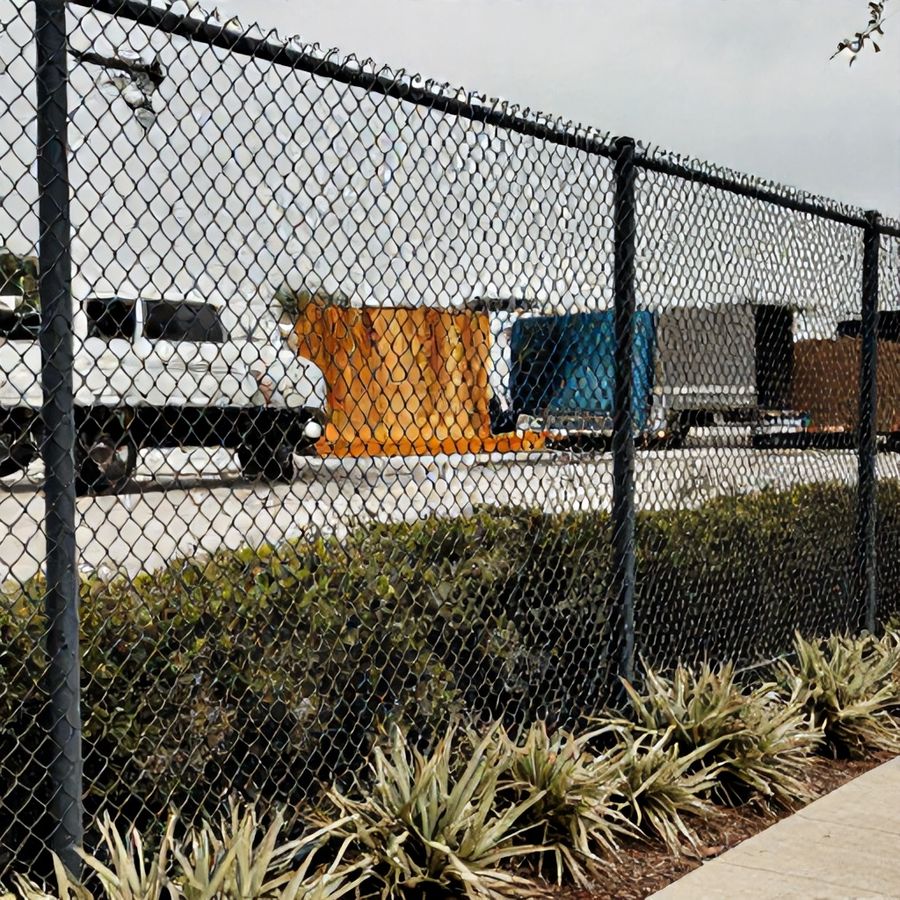
Chain link gives you almost no privacy. You can see straight through it, and so can your neighbor, which is fine for plenty of jobs and a dealbreaker for others. Slats get pitched as the fix - polyethylene, PVC, aluminum or vinyl strips woven into the mesh - and I’ve quoted plenty of them over the years. In my experience they rarely age well out here: the cheaper polyethylene ones fade within a couple of summers and start working loose at the ends, rattling in any real wind until half of them have walked out of the fence entirely. One independent source I found puts it about as bluntly as I would myself: slats are visually unappealing, less durable than the fence they’re attached to, and not commonly used for exactly those reasons. That tracks with what I saw on real jobs.
What chain link has that nothing else in this comparison offers is height and hardware. It can go up to 12 feet in commercial and security applications, and it accepts barbed wire, razor ribbon or a bottom tension wire when the job calls for it. One residential-framed source says 4 feet is typical for a home installation, which isn’t a contradiction so much as a different context - a backyard job and a commercial perimeter aren’t answering the same question.
Vinyl answers the privacy question differently, by offering a range within one material. Picket lets light through and semi-privacy narrows the gaps; step up to full privacy and the view closes off completely. It doesn’t match chain link’s height range, and it has no security-hardware option at all. Vinyl’s complete property profile, including how it holds up over time, is stated once on vinyl’s full profile, stated once. On speed, chain link goes up fast once posts are set and fabric is stretched on; vinyl takes longer, since each panel gets measured, leveled and secured on its own.
For whom each one wins
Chain link is the right call when the job is about containment and cost, not privacy or curb appeal: a side yard that just needs a boundary, a rental where the owner doesn’t want to sink money into looks, a dog run, or a commercial and utility application where the extra height or a security-hardware option actually matters. It’s the right call only where it’s allowed, though, and as the section above shows, that’s not everywhere in this metro. Check the restriction before you check the price.
If chain link survives that check, buy it vinyl-coated over bare galvanized, especially this close to the water. I can’t hand you a Tampa Bay-specific number on how many extra years that buys, because nobody has published one, but the mechanism holds up and every independent source agrees on the direction.
Vinyl wins wherever privacy or a finished, HOA-friendly look matters more than shaving the last dollar off the price. There’s no universal winner between these two. There’s a budget-and-security fence and there’s a privacy-and-appearance fence, and most of this decision comes down to which of those two jobs you’re actually hiring a fence to do.
Frequently asked questions
Is chain link cheaper than vinyl? Yes, and by a real margin: $12-20 a foot against $18-40 depending on the vinyl style you pick. Two things change that math fast, though - an HOA that won’t approve chain link, and in two jurisdictions covered above, a municipal rule that can take the option off the table before price even comes up.
Will an HOA allow chain link? Often not, in my experience, though I want to be honest that this comes from a single source describing a commonly reported pattern, not a rule I verified against every association. Community documents vary, and your own declaration is the real answer for your property. Separately, check whether your city or county allows chain link at all, because that’s a harder rule than any HOA’s.
Is vinyl-coated worth it over bare galvanized? Near this coast, yes, and every independent commercial source I found agrees on the direction. Nobody puts a Tampa Bay-specific number on how many extra years the coating buys, so treat it as sound advice rather than a guarantee. Clearwater’s own code reinforces the point from a different angle, since it treats vinyl-clad chain link more permissively than bare.
How long does chain link last? Commonly cited at 15-20 years, though sources range as wide as 10-25, or “up to 30” depending on environment and upkeep, with coated fence running longer than bare. Treat those figures loosely: one source contradicts itself on its own page, and a separate circulating claim, an 8-year coastal rust figure for coated fence, doesn’t hold up and shouldn’t be trusted.
How tall can chain link go? Up to 12 feet in commercial and security settings, with hardware options like barbed wire, razor ribbon or a bottom tension wire that nothing else in this comparison offers. For a home, though, expect residential norms, and in two jurisdictions here, municipal rules, to cap you well below that.
Check the restriction before you check the price. In two jurisdictions covered here, it decides the question outright, and no amount of savings changes that. If chain link survives that check, buy it coated, not bare. For how these bands were gathered and to price your own run, the estimator link is right there.
Sources
| Claim | Source | As of |
|---|---|---|
| Both installed-cost bands | This site’s own cost research, reused verbatim | July 2026 |
| Service life, coastal behavior, privacy, height, maintenance, installation speed, HOA acceptance | Commercial manufacturer and installer sources, conflicting in places | 2026 |
| Pasco County LDC §1003.1.G | Ordinance 24-45 (Nov. 12, 2024); Supplement 20 Update 1, codified through Ordinance 26-22 | June 16, 2026 |
| City of Clearwater CDC §3-805 (Art. 3, Div. 8) | Supplement 55, codified through Ordinance 9857-25 | Dec. 4, 2025 |
| ASTM designations | ASTM’s own catalog: F567-14a (Reapproved 2019), DOI 10.1520/F0567-14AR19, ASTM Committee F14; competing “F567-23” traced to an unconfirmed, paywalled reseller page and not used | Approved May 1, 2019 |
Cost bands gathered July 2026; municipal text verified July 28, 2026; page last reviewed July 28, 2026.
This site is an independent guide to fencing in the Tampa Bay area. It does not install fences, employ crews, sell materials, hold a contractor’s license or accept referral fees from anyone in the trade, and nothing above is a recommendation to use any specific brand or installer.
Code and permit claims reviewed by Dana Whitfield, CGC, certified building code inspector.


Code and permit claims reviewed by Dana Whitfield, CGC, certified building code inspector.
Florida-licensed general contractor, certified building code inspector. How we check facts: our sources and limits.
Read next
- Deferred-Interest Calculator: What It Costs If You MissEnter your own financing offer and see what deferred interest actually costs if a balance remains at the end of the promotional window - side by side with clearing it in time.
- Fence Cost Estimator for Tampa BayEstimate a fence in Hillsborough, Pinellas or Pasco by material, height, gates and terrain - with every rate shown, dated and sourced, and no email required.
- Mesh vs Permanent Pool Barrier: The Product QuestionRemovability, sightlines, upkeep and what nobody independent has published about how long mesh lasts - a product comparison. Florida's barrier law is answered separately.
Want a quote read by someone who has no stake in it?
We do not install fences. Tell us what you are planning and we pass the request to a licensed contractor who works your area.
Request a callback
Enter your number and we will call you back. Nothing else is required.
We do not install fences. Your request goes to a licensed contractor who works your area, and we may be compensated for the introduction.
Advertiser disclosure. This page can earn us money. If your request reaches a contractor through the form or the phone number above, we may be compensated for that introduction. It has never determined what any page on this site says, and no contractor has editorial input. We hold no contractor licence of our own and perform no work.