Fence Projects in Tampa Bay: Find the Job That Matches Your Yard
Fifteen fence and gate jobs written one situation at a time, for homeowners in Hillsborough, Pinellas and Pasco who want to understand the work before three installers explain it to them. We do not install fences and we do not sell them.
What decides a fence job here, before anyone picks a material
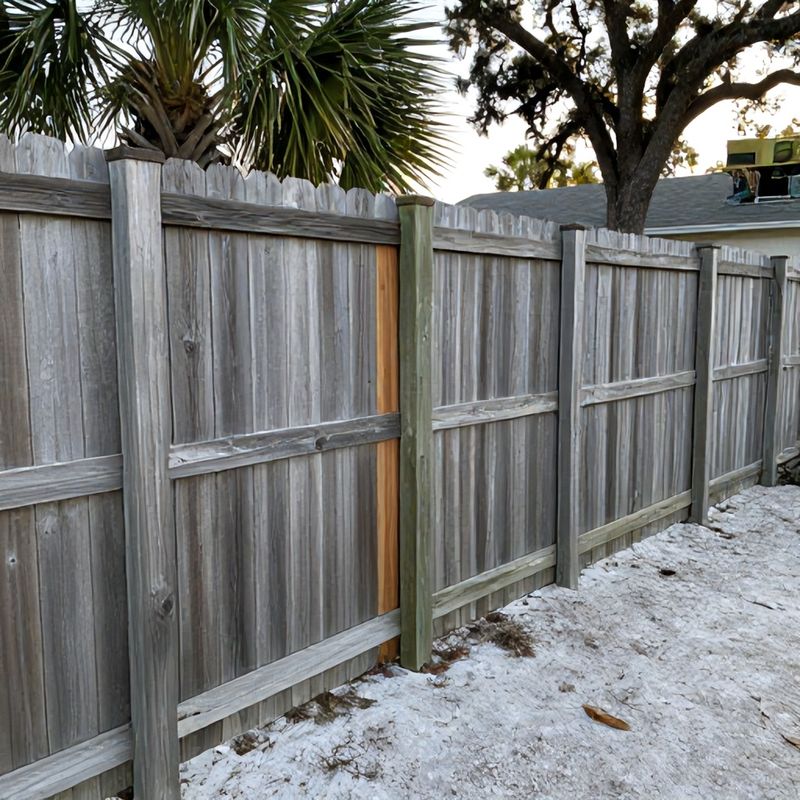
Almost every argument about a fence quote in this metro comes down to what happens below grade, and almost no quote explains it. A post carries load in one of two ways. A line post, standing in the middle of a straight run, resists wind spread across many posts beside it.
Put that same post at a corner, at the end of a run, or beside a gate opening and it becomes a terminal post, taking concentrated tension or torque from one or two directions at once. A gate post gets all of that plus the weight and the swing leverage of the leaf hanging off it. Trade practice grades them differently for exactly that reason: heavier gauge, larger diameter, a wider and deeper footing.
Wheatland's own chain link specification scales terminal and gate post diameter directly to gate leaf width and fabric height, which confirms the mechanic even where it does not settle the numbers.
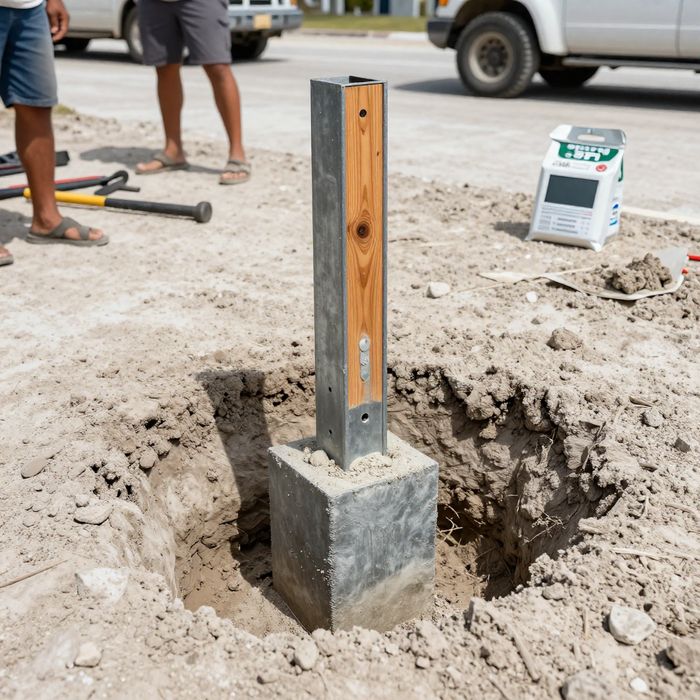
Depth is where the sources stop agreeing. A widely repeated trade rule buries roughly one third of the post's total length, with a practical floor near 24 inches for a standard residential post.
Applied to a nominal six-foot fence, published figures land anywhere between about 24 and 38 inches depending on which total post length the source assumed and whether it layered soil or wind exposure on top.
One source states outright that the one-third figure is a construction heuristic rather than a code mandate; another writes as though model codes reference it directly. That disagreement is real and we are not going to resolve it for you with a confident number. Hole diameter has the same problem, with guidance ranging from three to four times the post's own cross section.
Soil turns the disagreement into money. Loose, well-draining sand gives up less side-bearing resistance per inch of depth than dense clay, so the same post needs to go deeper, sit in a wider footing, or both. A footing belled wider at its base than at its top is reported to hold better in sand than a straight concrete plug, which can polish the surrounding grains and let the post rock over a few seasons.
Whether gravel at the bottom of the hole helps in ground that already drains is an open trade argument with three defensible positions, and any installer who tells you it is settled has not read the other two.
If your project has a price question attached, the numbers live in what a fence actually costs per linear foot here rather than on this page.
Wind load is about panel style, not height
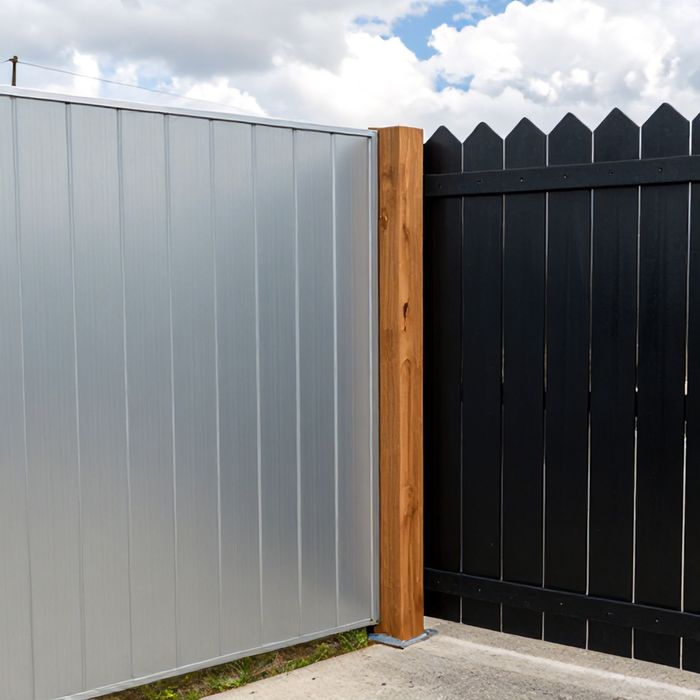
Force on a fence is wind pressure multiplied by the panel's solid area. A privacy panel shows its whole face to the wind. An open style, whether chain link, ranch rail, picket with gaps or ornamental aluminum, lets most of the air through and sheds a large share of the lateral load at the same height.
That single mechanic explains why solid privacy runs want tighter post spacing and bigger footings, why an open perimeter stays the economical choice on long runs, and why raising a solid fence by two feet costs more than two feet of extra material: the sail area grows and the lever arm above grade grows with it.
There is a myth attached to this, and in Florida it is expensive. Tampa Bay is not in the High-Velocity Hurricane Zone. Florida Building Code, Residential, section R4403.9.2 sets the 170 mph and 175 mph structural wind velocities for Broward and Miami-Dade, and that chapter is scoped to those two counties by name.
Hillsborough, Pinellas and Pasco do sit inside the separate and much broader Wind-Borne Debris Region, which is a rule about windows, doors, garage doors and skylights, not about fences. Anyone quoting a hurricane engineering requirement for a residential fence in this metro is conflating the two designations.
Storm-resilient building here is voluntary practice and worth paying for on its own merits, which is the whole argument of the wind-rated fence page.
Salt air eats the hardware before it touches the fence
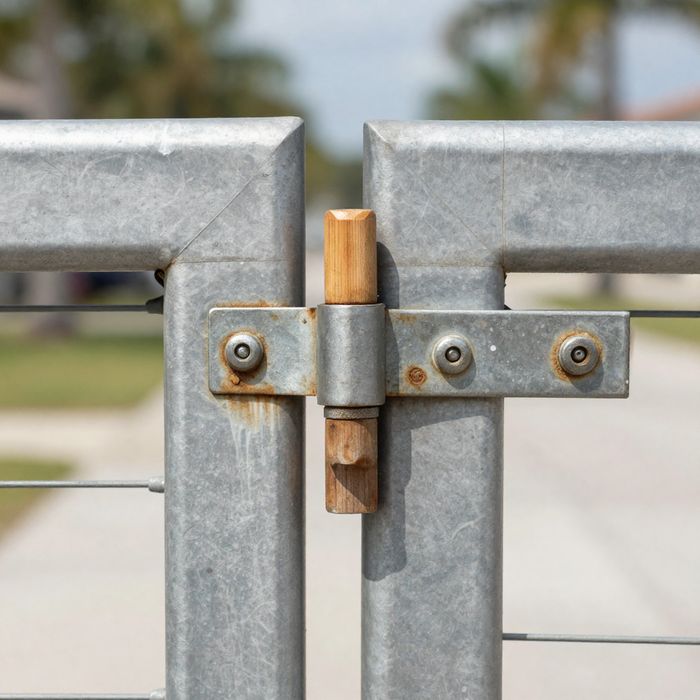
Chloride in coastal air accelerates corrosion of ferrous metal. Galvanized steel survives by letting the zinc layer corrode sacrificially in place of the steel underneath, and near the water that zinc is consumed faster than it would be twenty miles inland. The fence fabric usually outlives the fasteners, so the parts that fail first are the small ones: hinges, latches, screws, the pin your gate swings on.
Grade matters more than the label.
Two independent hardware sources put molybdenum in 316 stainless and not in 304, which makes 316 the genuine marine grade and 304 the ordinary one; a coastal contractor source describes "marine-grade stainless steel (304 or 316 series)" as though both qualify, and that position conflicts with the better-corroborated one.
Bronze avoids the question by having nothing in it that rusts, developing a patina instead, with silicone bronze fasteners recommended for structural fastening at a premium. Mixing metals is its own failure: plain steel fasteners against an aluminum frame invite galvanic corrosion right at the contact point in humid, salt-laden air.
Titon's guidance is worth repeating in a sentence, because it is the only vetting rule here that costs nothing: ask for salt-spray-chamber evidence rather than accepting a marine-grade sticker.
Who is allowed to do this work, and what that answer is worth
Fence installation is not one of the construction categories Florida licenses at state level. The Department of Business and Professional Regulation's own contractor list runs from air conditioning through underground utility and excavation without naming fence anywhere.
House Bill 735 in 2021 then pre-empted local occupational licensing outside the state categories, with a carve-out for a local fence license that predates 1 January 2021.
For a long time we published that carve-out as an open question. It is now answered, and the answer splits by county, which is more useful than the hedge it replaced.
Pinellas County has a category: Fence Erection Specialty Contractor, scope defined by the Pinellas County Construction Licensing Board since 21 March 1995 and still on the board's live license-type list as of July 2026, with a 2026 to 2027 fee schedule of $250 to apply and $150 to renew.
Whether the board still issues new fence licenses after HB 735 or only maintains existing ones is unconfirmed, and the board itself is the place to ask, on 727-582-3100. Pasco County does not have one: a closed, numbered list of 32 competency categories revised 2 January 2024, in which the word fence never appears. Hillsborough does not either, on the county's own current local specialty list.
So a Clearwater or St. Petersburg reader can ask an installer a licensing question and check the answer with a board. A reader in Riverview or Wesley Chapel cannot, because there is nothing to be licensed as.
In those two counties the buyer is the vetting authority, and written scope, proof of insurance, permit ownership and staged payment documentation do the job that a licensing board does elsewhere.
Whether chapter 489's buyer protections reach an unlicensed-by-design trade is unsettled in law, and the page on reading a fence quote owns that boundary rather than assuming an answer.
The pre-quote checklist
Nine questions, drawn from the failure modes above rather than from a sales script. They work on any of the fifteen jobs on this page, and an installer who answers them cleanly has told you more than any review page will. Two of them almost never get asked, and those two are the ones I would ask first.
- How deep will the posts go, and why that depth for my soil? A single blanket number applied regardless of ground type is the answer to watch for.
- What size and shape footing, and does it change in sand? Belled or straight, and on what basis.
- Are terminal, corner and gate posts specified heavier than line posts? If the quote lists one post spec, the load roles were not considered.
- What alloy or coating is the hardware, and is there test evidence? A grade number beats an adjective.
- Do hardware metals match the fence material? Steel fasteners on aluminum is a scheduled failure, not a preference.
- Who calls 811, and how many days before digging? Florida chapter 556 requires notification before excavation, names fence installation explicitly, gives at least two full business days, costs nothing, and sets a 24-inch tolerance zone around each marked facility where digging goes to hand tools. Civil penalties reach $2,500 on hazardous pipeline violations. This one question sorts professionals from crews faster than any other.
- Who pulls the permit, in whose name, and what happens if none is required? The jurisdiction matrix has your authority's current position.
- Is the old footing coming out? Reusing a rotted post's concrete with degraded debris still in it transfers the same moisture conditions to the new post.
- What is written down before any money moves? A scope, proof of insurance, and payment tied to milestones rather than to a calendar, in a trade with no state licensing floor to fall back on.
For an automated gate, add a tenth: two independent entrapment-protection device types per zone per direction, monitored, not one sensor doing double duty. The automatic gate page explains what that looks like on a real installation.
What this hub does not do
We do not install fences, employ crews, hold a contractor license, or publish reviews of local companies.
Ray Vasquez spent twenty-two years setting posts in Hillsborough and Pinellas and four more as an estimator, and this site exists because that combination makes a quote readable in a way that a sales visit never will.
When a page has no local number, it says so rather than borrowing a national average. Composite pricing is the standing example: no Tampa Bay figure exists for it after repeated searching, and the closest honest proxy is a Florida-wide one, labeled as such wherever it appears.
Everything in this hub
Keeping an animal in
- Fence for Dogs: Height, Digging and Gate Hardwarewhole-yard containment, where height, gaps and digging are three separate failure modes.
- Dog Run: How Big, Where, and What Goes on the Floora bounded structure with its own placement, flooring and shade decisions, for when fencing the whole yard is the wrong answer.
Getting in and out
- Driveway Gate: Swing or Slide, and Why the Posts Cost Moremanual operation, where site geometry rather than preference decides the type.
- Automatic Driveway Gate: The Safety-Device Questionthe automation layer on top, including the electrical trade referral and a price band that runs from a couple of thousand to five figures nationally.
- Walk Gate Installation: The Detail Buyers Skipstandard hardware, until the gate serves a pool and self-closing stops being optional.
Working with the site you have
- Fencing a Sloped Yard: Racked or Stepped, and What It Addsa technique problem driven by grade change, with a labor surcharge that belongs itemized on the quote.
- Privacy From a Two-Story Neighbor When You Can't Go Tallerthe combination approach for a yard with a fixed height ceiling. This page states no height figure, because yours depends on your jurisdiction.
- Wind-Rated Fence: What Is Actually Required Herea correction. The strictest hurricane engineering tier does not reach this metro.
Around water and equipment
- Above-Ground Pool Fence: The Installation Decisiona legally significant barrier whose result an inspector checks, with the ladder condition that decides it.
- Screening Pool Equipment Without Blocking Servicedecorative screening with no barrier function at all, and the service clearance that is its real requirement.
Keeping what is already there
- Rotted Wood Fence: One Post, or the Whole Run?diagnosis first, then the patch-versus-replace decision, with local repair bands from a named contractor.
- Staining a Wood Fence Here: The Interval Nobody Marketsthe only job on this page that is a schedule rather than an event.
Permission rather than construction
- HOA Fence Approval: What They Can Actually Deny You Forprivate architectural review, its statutory limits, and the 30-day rule that turns out not to exist.
Non-residential and short-term
- Commercial Chain Link: Why It Isn't a Taller Residential Fencea different buyer, a different gauge, a different code chapter.
- Renting a Fence: Job Site, Event, or a Pool-Code Gapfreestanding panels, no post holes, priced by the month.
Questions this hub answers
Does this site install fences?
No. We do not install, subcontract or broker fence work, hold no contractor license and publish no reviews of our own. The site explains the job so you can judge the quotes you receive. Where a page connects you with a contractor, that is disclosed on the page itself.
Is fence installation a licensed trade in Tampa Bay, and does that protect me?
It depends which county your parcel sits in, which is not the answer most sources give. Florida licenses no fence category at state level, and HB 735 pre-empted local licensing in 2021 with a carve-out for pre-2021 local licenses. Pinellas County kept one, Fence Erection Specialty Contractor, and it is live today.
Do I need a permit before starting any of these jobs?
That question has eighteen different answers across this metro and they do not correlate with city size. Unincorporated Hillsborough and Pasco exempt most standard residential fences; New Port Richey requires a permit for every fence, no material or height exception. The jurisdiction table carries each authority's own document and date, including the rows that remain unresolved.
Who calls 811, and how long before the crew digs?
Florida chapter 556 requires notification before excavation and names fence installation explicitly. At least two full business days, free of charge, with a 24-inch tolerance zone around each marked line where digging must go to hand tools or vacuum excavation. If your installer treats this as optional, that tells you something about the rest of the job.
How deep do fence posts need to go in Florida sand?
Deeper than the same post would need in clay, and no source we found agrees on the exact figure.
Which page should I read first?
Start with the job, not the material. If you are choosing between wood, vinyl, aluminum or chain link rather than solving a specific situation, the materials comparisons are the better entry point.
This page explains how fence and gate work is scoped, priced and inspected in the Tampa Bay area. It is general information, not construction advice, legal advice or a compliance determination for your property. Tampa Bay Fence Co. does not install fences, does not employ installation crews and holds no contractor license. Code sections, permit positions, licensing categories and fees change, and they differ between one side of a city limit and the other; confirm anything that affects your project with the authority named on the page you are reading. Where a page connects you with a contractor, we may be compensated, and that arrangement never decides what a page says.
Code, permit and safety claims on this page reviewed by Dana Whitfield, CGC, certified building code inspector.
Want a quote read by someone who has no stake in it?
We do not install fences. Tell us what you are planning and we pass the request to a licensed contractor who works your area.
Request a callback
Enter your number and we will call you back. Nothing else is required.
We do not install fences. Your request goes to a licensed contractor who works your area, and we may be compensated for the introduction.
Advertiser disclosure. This page can earn us money. If your request reaches a contractor through the form or the phone number above, we may be compensated for that introduction. It has never determined what any page on this site says, and no contractor has editorial input. We hold no contractor licence of our own and perform no work.