Fence Projects
Privacy From a Two-Story Neighbor When You Can't Go Taller
When the height cap is already maxed out, real privacy comes from a topper, landscaping and placement - not a taller fence. The combination that actually works.
By Ray Vasquez · Published July 28, 2026 · Last checked July 28, 2026
On this page
A homeowner staring up at a neighbor’s second-story window almost always asks the same question: can I just build my fence taller? Usually not. This is an engineering and zoning problem worked inside a fixed height ceiling, not a bigger version of an ordinary privacy fence. The exact ceiling for your address lives on the height and setback page, not here. What follows works inside it, one entry in the rest of the fence projects we cover.
This is an independent guide to fencing in the Tampa Bay area. It installs nothing and holds no contractor’s license - the toolkit below is information, not an offer.
What Actually Adds Privacy When the Fence Can’t Go Higher
Most residential zoning in Hillsborough, Pinellas and Pasco caps how tall a solid fence section can go, and that cap comes from local government, not a contractor. Confirm your own limit before planning anything specific.
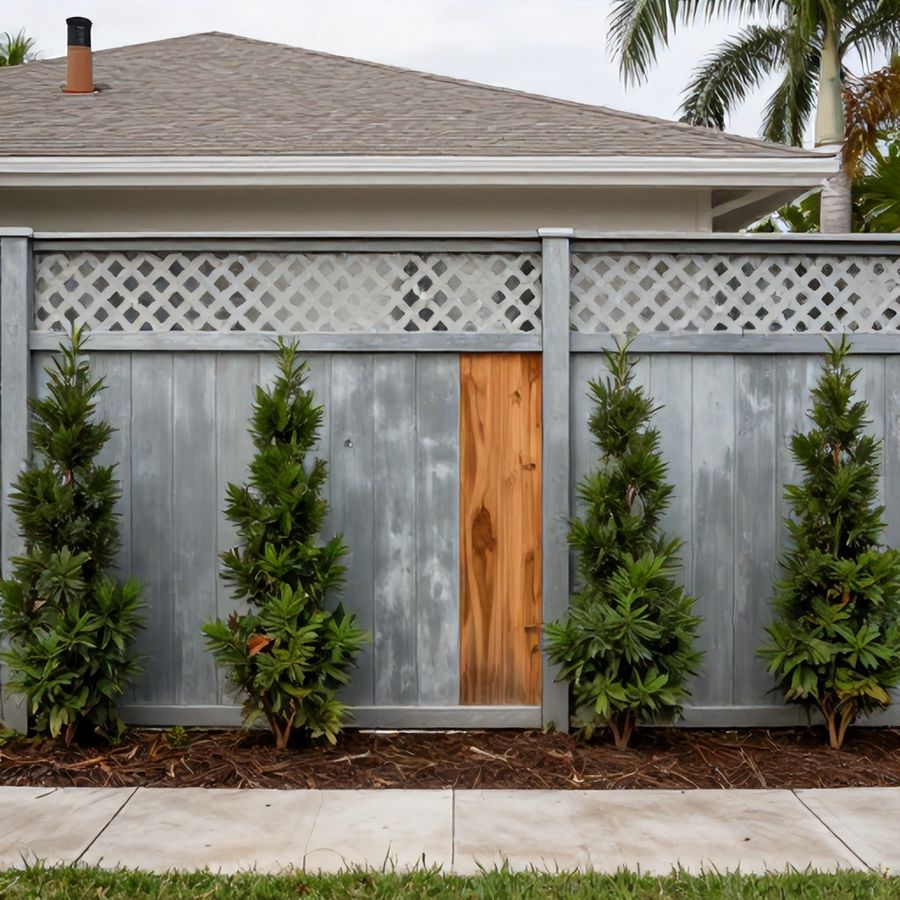
Inside whatever ceiling applies, three moves change what a second-story window can actually see. A lattice or trellis topper above the solid section works when it’s aimed right at the sightline, though whether an open-style topper counts as fence height depends entirely on the jurisdiction - I’ve never found a rule that holds everywhere, so ask before assuming either way. Staggered evergreen landscaping alongside the run gets there slower, but sidesteps the height debate completely. Offsetting the fence line inward, where the lot has slack, changes the sightline’s angle enough that less height gets needed at all.
One thing changes once a solid section hits the tallest height any jurisdiction allows: the post underneath carries more wind load and a longer lever arm than a standard-height run, which is why going taller commonly means a deeper footing or a heavier post, not just more material. I learned that lesson backward, setting a vinyl run too shallow in sugar sand years back - skip the deeper footing here and a privacy upgrade leans by the next storm season.
| Approach | What it adds | Its real limit |
|---|---|---|
| Lattice or trellis topper | Height right where the sightline needs blocking | Whether it counts as fence height depends on the jurisdiction - confirm before building |
| Staggered evergreen landscaping | Coverage that never enters the height debate | Takes years to mature into real screening |
| Offset placement | Changes the sightline’s angle so less height is needed | Only works where the lot actually has room to give up |
What This Actually Costs
Standard-height privacy pricing is the honest baseline: wood privacy at six feet runs roughly $18-32 a linear foot here, vinyl at the same height roughly $25-40. Push to the tallest privacy height a jurisdiction allows and expect roughly 1.6 to 2 times that per-foot number. What a topper or landscaping supplement adds on top is a real gap - it hasn’t been priced in this site’s research, and I’d rather say so than invent a figure. The full linear-foot breakdown covers the base numbers.
Licensing and the Height Cap Are Two Different Questions
Pinellas County has carried a Fence Erection Specialty Contractor category since March 21, 1995, still listed as of this writing, though whether it’s still issuing new licenses under it is an open question. Pasco and Hillsborough carry no such category. None of that touches your height ceiling - that’s a zoning rule your local government sets, separate from whether an installer holds a trade license.
Red Flags to Watch For
An installer who states flatly that a lattice topper never counts toward height, or always does, isn’t being honest - it depends on the jurisdiction and has to be checked. A quote for a taller solid section using the same post spacing as a standard-height run deserves a follow-up question, since that combination commonly doesn’t hold once wind load changes. And before anyone digs a deeper footing, the utility locate call isn’t optional: Florida law requires notice at least two business days before excavating, and Sunshine 811 makes the call free.
The Honest Verdict
An extra-tall privacy fix is almost always a combination - a code-maximum fence plus a topper, landscaping or placement - not simply a taller fence, since most municipalities cap solid height well short of a second-story sightline. Confirm the exact local limit first, then build around whatever number comes back.
Which Combination Fits Your Overlook
Match your situation to the move that fits, then confirm your height ceiling before building anything.
- A single upstairs window has a direct line of sight: lead with a topper positioned right at that sightline.
- The view comes from a deck or several windows at once: a topper alone won’t cover the spread, so lead with staggered landscaping instead.
- The lot has slack on one side: offset placement cuts how much height the problem even needs.
Whichever applies, confirm your exact height ceiling first - that number isn’t on this page.
Frequently asked questions
Can I just build my privacy fence taller to block my neighbor’s view? Usually not on its own. Most residential zoning caps solid fence height, and the exact number for your address is on the height and setback page. Once you know that ceiling, the combination above is the real answer.
Can a lattice topper go above the height limit? It depends on the jurisdiction - never universally allowed, never universally counted as height either. Check with your local zoning office first.
Does going taller cost a lot more? Yes, roughly 1.6 to 2 times the per-foot rate at the tallest common privacy height, on top of the $18-32/lf wood or $25-40/lf vinyl baseline above. A topper or landscaping supplement isn’t part of this site’s cost research.
Confirm your exact height ceiling on the height and setback page before planning a combination. See what a taller section does to wind load, in full, and, where it applies, when the lot is sloped as well as overlooked. The rest of the fence projects we cover is the hub for everything else.
Sources
| Claim | Source | As of |
|---|---|---|
| Licensing split by county | Pinellas County Construction Licensing Board live license-type list; Pasco County competency-category list; Hillsborough County contractor-licensing page | 2026-07-28 |
| Utility-locate duty before excavating | Fla. Stat. ch. 556; Sunshine 811 | 2026-07-28 |
| Cost bands (wood and vinyl privacy baseline) | This site’s own linear-foot cost research | July 2026 |
| Combination toolkit and wind-load/post-spec mechanic | This site’s own research on overlook-privacy technique | dossier compiled 2026-07-28 |
Licensing and utility-locate facts above were last checked July 28, 2026.
This is an independent guide to fencing in the Tampa Bay area. It does not install fences or hold a contractor’s license, and nothing above is a code citation or a permit determination for your address.
Read next
- Above-Ground Pool Fence: The Installation DecisionWhether your above-ground pool's own wall counts as the barrier, when a separate fence is required, and what the ladder question really means.
- Automatic Driveway Gate: The Safety-Device QuestionWhat a gate opener's safety devices must include, why the wiring is a separate trade, and why the price spread is wide - with no confirmed Tampa Bay figure yet.
- Commercial Chain Link: Why It Isn't a Taller Residential FenceThe real spec difference between commercial and residential chain link, the standard everyone cites wrong, and two municipal rules here that can restrict it outright.
Want a quote read by someone who has no stake in it?
We do not install fences. Tell us what you are planning and we pass the request to a licensed contractor who works your area.
Request a callback
Enter your number and we will call you back. Nothing else is required.
We do not install fences. Your request goes to a licensed contractor who works your area, and we may be compensated for the introduction.
Advertiser disclosure. This page can earn us money. If your request reaches a contractor through the form or the phone number above, we may be compensated for that introduction. It has never determined what any page on this site says, and no contractor has editorial input. We hold no contractor licence of our own and perform no work.