Fence Projects
Commercial Chain Link: Why It Isn't a Taller Residential Fence
The real spec difference between commercial and residential chain link, the standard everyone cites wrong, and two municipal rules here that can restrict it outright.
By Ray Vasquez · Published July 28, 2026 · Last checked July 28, 2026
On this page
A different buyer, a different spec
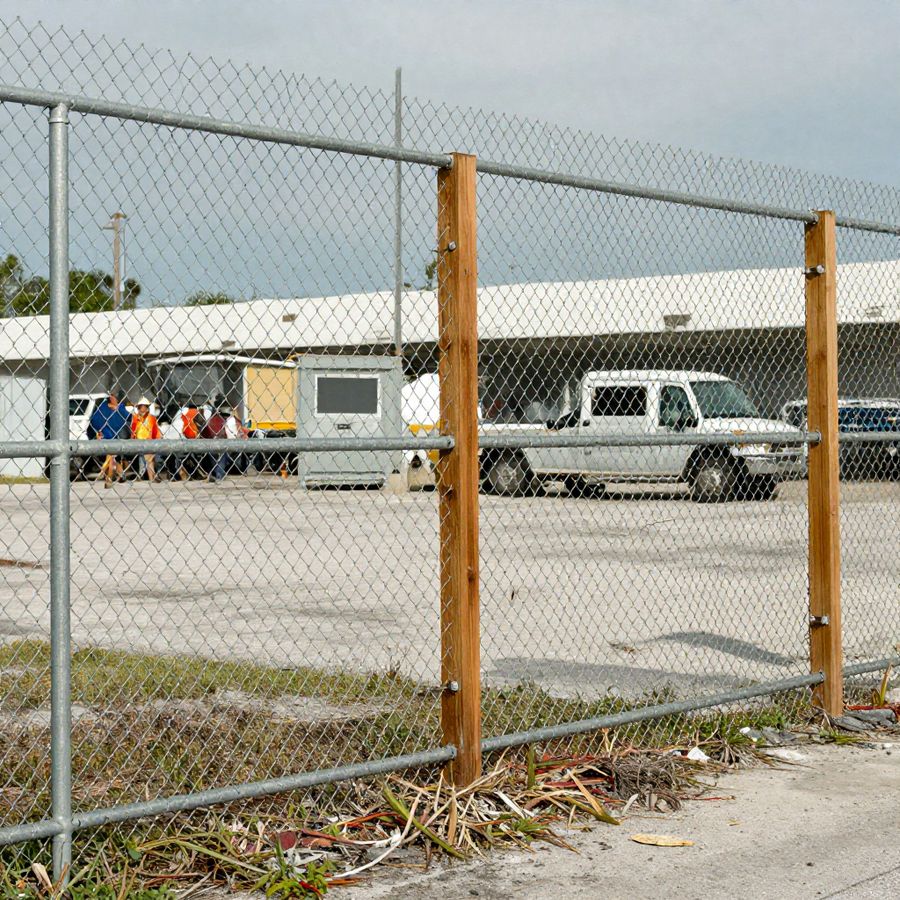
A commercial chain-link job isn’t a taller residential one. The buyer’s different - a property manager or business owner, not a homeowner - and so is the spec: gauge, height, code chapter, bracing, all of it. Price a commercial run like a residential one and you’ll under-spec the job before the first post goes in.
How this site works
This site is an independent guide, not an installer - no crew, no bids, no license number of its own. Fence work isn’t a state-licensed trade in Florida, though counties handle it differently; more on that below. The rest of the fence projects we cover live at the hub.
The spec, and a standard worth naming correctly
Residential-grade chain link commonly runs 4 to 6 feet at 11 or 11.5-gauge. Commercial commonly runs 6 to 10 feet at 9-gauge, with a documented breaking load around 1,290 lbf. Security and athletic-grade runs 10 to 12 feet, tighter mesh, heavier gauge still.
| Tier | Height | Gauge | Breaking load |
|---|---|---|---|
| Residential | 4-6 ft | 11 / 11.5-gauge | not documented at this tier |
| Commercial | 6-10 ft | 9-gauge | ~1,290 lbf |
| Security / athletic | 10-12 ft | heavier, tighter mesh | not documented at this tier |
Here’s a correction worth knowing: ASTM F2408 gets cited constantly for chain-link fabric, and it’s wrong - that standard covers ornamental galvanized steel tube fencing, a different product. The designation I verified is ASTM F567-14a (Reapproved 2019); a competing “F567-23” traces to an unconfirmed paywalled reseller and isn’t used here. Designations only - never what a standard requires, since chain-link standards are a family, not one document.
CLFMI’s manual targets a 20.0 MPa, 28-day concrete footing, with horizontal bracing to the nearest line post above 6 feet of fabric height. Weighing chain link against another material? The material verdict against vinyl covers that - this page owns the spec, not the comparison.
The buyer this job is actually for
Commercial fence projects more commonly fall under the model Building Code (IBC) rather than the Residential Code (IRC) that governs a home fence, which can affect post-embedment depth, wind-load math, and inspection milestones. Excavation past roughly 5 feet can trigger separate OSHA excavation-safety obligations - one commercial source flags this, and a residential-focused installer may never have run into it.
Gate types commonly run to double-swing and cantilever slide gates for vehicle access - the residential gate-post mechanics this scales up from - and pedestrian gates serving a place of public accommodation raise their own accessibility-clearance questions.
Before you price it - where this metro restricts chain link
This can end the decision before gauge or price ever comes up. Pasco County prohibits chain link, welded wire, or similar fences and gates visible from a collector or arterial roadway, county-wide, unless the property is zoned industrial. Clearwater treats chain link as its own regulated class: banned in the Downtown District and in front of the principal structure, capped at 48 inches (or 6 feet if clad in green or black vinyl), banned where a side or rear lot line abuts a right-of-way, and required to be landscaped. Section, supplement and date for both sit in the table below.
| Jurisdiction | Restricted | Section | Supplement / date |
|---|---|---|---|
| Pasco County | Chain link visible from a collector or arterial road, outside industrial zoning | LDC §1003.1.G | Supp. 20 Update 1, through Ord. 26-22 (16 Jun 2026) |
| City of Clearwater | Chain link as its own class - Downtown, front yard, right-of-way, height, landscaping | CDC §3-805 | Supp. 55, through Ord. 9857-25 (4 Dec 2025) |
| Every other jurisdiction in this metro | Not established here | - | see the permit table |
A commercial site in either jurisdiction can lose the option, or its economics, before anyone prices gauge. Dimensional content beyond the two restrictions named here covers setbacks generally - this page doesn’t expand into a municipal survey.
What this costs
No dedicated commercial figure exists in this site’s cost research. Expect a materially higher per-foot cost than the residential bands - heavier gauge, taller fabric, and commercial-scope code requirements all push it up. See why no commercial figure exists yet for how the residential bands are built, if you want the comparison; I’d rather state the absence honestly than borrow that number.
Who’s allowed to do this
Same baseline as residential: Pinellas names a fence contractor category (PCCLB, 727-582-3100); Pasco and Hillsborough don’t. The commercial-scope nuance: this work commonly falls under a different code chapter and may carry separate bonding or insurance expectations from a property owner or manager, even though the underlying licensing picture matches residential.
Red flags
An installer proposing residential-scope gauge, height, or footing for a commercial job is the first flag. So is no mention of the code-chapter difference, or a bid that ignores either municipal restriction where the site actually sits. Deep excavation with no named worker-safety plan is the fourth.
Honest verdict
This is a genuinely different buying decision, not a taller version of the same thing. The first vetting question: does the installer actually have commercial-scope experience - code chapter, bracing spec, gate type - not just residential? In two jurisdictions here, the municipal restriction can remove the “cheap chain link” option before spec or price comes up. I quoted a job once where the property manager assumed a residential-scope bid covered it. It didn’t.
Frequently asked questions
What’s different about a commercial-grade chain link fence versus a residential one? Gauge and height, mainly - residential runs 4 to 6 feet at 11 or 11.5-gauge, commercial 6 to 10 feet at 9-gauge - plus a different code chapter. The fabric standard most sites cite, ASTM F2408, is also wrong; the verified designation is ASTM F567-14a.
Does my city or county restrict chain link for a commercial site? Two jurisdictions here do: Pasco County (LDC §1003.1.G) and Clearwater (CDC §3-805), each detailed above. Every other jurisdiction in this metro isn’t established in this research - don’t assume either way.
What gate types fit commercial vehicle and pedestrian access? Double-swing and cantilever slide gates cover vehicle access most commonly. Pedestrian gates serving a place of public accommodation raise their own accessibility-clearance questions.
Check both the spec and the two municipal restrictions before pricing anything - either one can change the job before gauge is even discussed.
Sources
| Claim group | Source | As of |
|---|---|---|
| Gauge/height/breaking-load table | Wheatland Tube chain-link and gate specifications | 2017-12 |
| Footing/bracing spec | CLFMI Product Manual, Section 32 31 13 | Undated |
| Standards correction (F2408 vs. F567-14a) | Verification pass, ASTM catalog cross-check | July 28, 2026 |
| Code-chapter and excavation-safety points | Single commercial source | 2026, not independently verified |
| Pasco §1003.1.G | Pasco County LDC, Supplement 20 Update 1, through Ord. 26-22 | 16 Jun 2026 |
| Clearwater §3-805 | City of Clearwater CDC, Supplement 55, through Ord. 9857-25 | 4 Dec 2025 |
| Licensing baseline | PCCLB classification records; Pasco Certificate of Competency application | Retrieved July 28, 2026 |
Municipal text and standards designation verified July 28, 2026; page last reviewed July 28, 2026.
This site is an independent guide to fencing in the Tampa Bay area. It does not install fences, employ crews, or hold a contractor’s license, and nothing here is a bid, a permit determination, or legal advice.
Code and permit claims reviewed by Dana Whitfield, CGC.


Code and permit claims reviewed by Dana Whitfield, CGC, certified building code inspector.
Florida-licensed general contractor, certified building code inspector. How we check facts: our sources and limits.
Read next
- Above-Ground Pool Fence: The Installation DecisionWhether your above-ground pool's own wall counts as the barrier, when a separate fence is required, and what the ladder question really means.
- Automatic Driveway Gate: The Safety-Device QuestionWhat a gate opener's safety devices must include, why the wiring is a separate trade, and why the price spread is wide - with no confirmed Tampa Bay figure yet.
- Dog Run: How Big, Where, and What Goes on the FloorSizing, placement and flooring for a dedicated dog run - drainage, shade and dig-guard questions before you build. No dog-run-specific cost figure exists yet.
Want a quote read by someone who has no stake in it?
We do not install fences. Tell us what you are planning and we pass the request to a licensed contractor who works your area.
Request a callback
Enter your number and we will call you back. Nothing else is required.
We do not install fences. Your request goes to a licensed contractor who works your area, and we may be compensated for the introduction.
Advertiser disclosure. This page can earn us money. If your request reaches a contractor through the form or the phone number above, we may be compensated for that introduction. It has never determined what any page on this site says, and no contractor has editorial input. We hold no contractor licence of our own and perform no work.