Fence Projects
Wind-Rated Fence: What Is Actually Required Here
Hurricane-tier wind rules for fences apply only in Miami-Dade and Broward, not here. What drives wind resistance, and what helps voluntarily in Tampa Bay.
By Ray Vasquez · Published July 28, 2026 · Last checked July 28, 2026
On this page
A One-Page Exception, Not a Theme
This page exists for a modest but real search signal, even though the broader demand behind this hub shows almost no interest in a storm or wind angle. Among the rest of the fence projects we cover, it’s the one deliberate exception.
What Actually Drives Wind Exposure
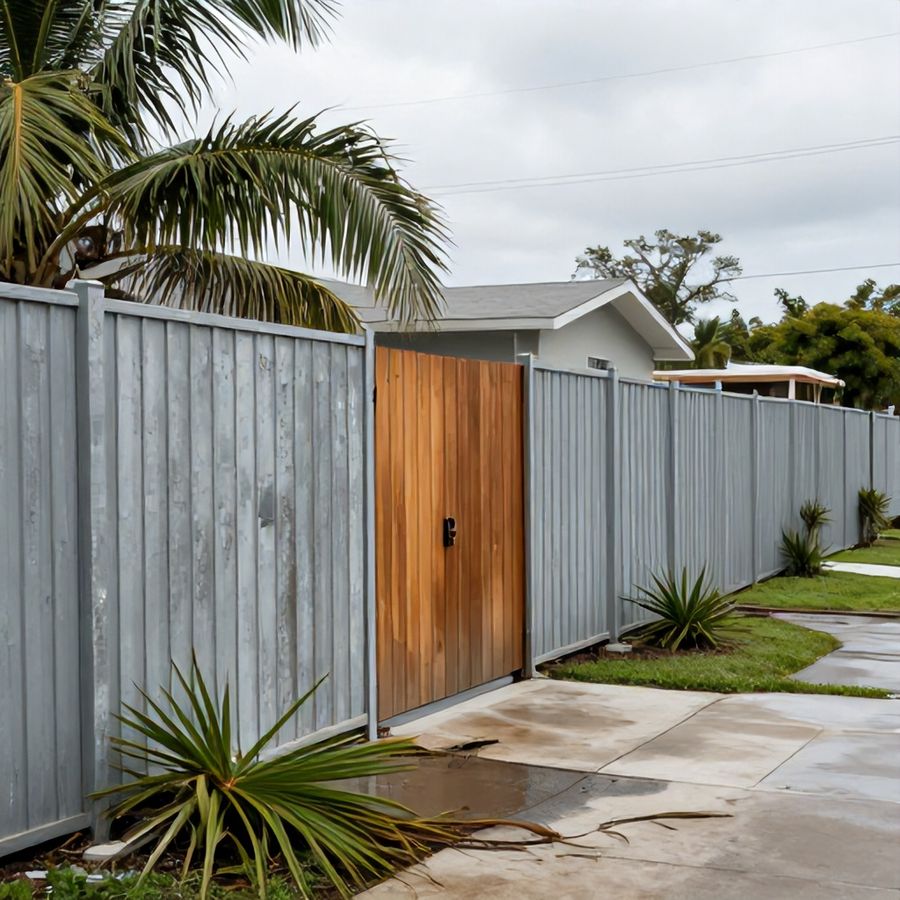
Wind force on a fence panel is pressure times solid area - the sail effect, mechanics, not a rating. A solid privacy panel presents its whole face to the wind; an open style, chain link, picket with gaps, most ornamental metal, lets wind pass straight through and cuts the net load at the same height. A solid privacy run on an open, exposed lot is, functionally, a sail. That’s physics, not a rating anyone can buy.
What Is Actually Required Here
Florida’s toughest wind-engineering tier, the High-Velocity Hurricane Zone, is scoped to exactly two counties: Miami-Dade and Broward (Florida Building Code, Residential, Section R4403.9.2). Hillsborough, Pinellas and Pasco aren’t in it. This metro sits in a separate, broader Wind-Borne Debris Region instead - that designation governs impact protection for windows and doors, not fences, and nothing here shows a Tampa Bay county requiring engineered wind-load documentation for one. Outside the HVHZ, fence codes generally carry no such requirement.
High-Velocity Hurricane Zone vs. Tampa Bay
| Zone | Wind-engineering requirement | Applies here? |
|---|---|---|
| High-Velocity Hurricane Zone (Miami-Dade, Broward) | Engineered wind-load requirements for structures | No, two counties only |
| Hillsborough, Pinellas, Pasco | Inside the broader Wind-Borne Debris Region (governs openings, not fences); no fence mandate found | Yes, this is us |
What an Installer Can Actually Do, Voluntarily
None of this is required here - it’s a menu, not a code: deeper post embedment, a wider footing, steel posts instead of lighter ones, a reinforced gate post on a driveway gate, all optional. Whether shadowbox or board-on-board actually handles wind better is genuinely contested - the wind question nobody has measured covers that fight honestly, and I’m not resolving it here either.
What an installer actually controls (ask for it, never assume it)
- Post embedment depth - deeper holds better, a request here, never a code minimum
- Post diameter - heavier resists bending load
- Footing size - larger anchors the post more firmly
- Post spacing - tighter shares wind load across more posts
- Hardware grade - heavier brackets and fasteners hold up longer under gusts
Cost
No source here prices a wind-rated premium, because no such product exists. The same standard material bands apply - see how the standard material bands are gathered - and a heavier voluntary post or footing spec isn’t quantified separately anywhere.
Legitimacy
Pinellas has a “Fence Erection Specialty Contractor” category (Construction Licensing Board, 727-582-3100); Pasco and Hillsborough don’t. It barely matters here - storm resilience is a voluntary choice, not a licensing question.
Red Flags
A “hurricane rated” fence, or a wind-load figure attached to one - no source backs a number like that. A seller implying HVHZ documentation is required here when it isn’t. A tall, solid privacy run on an exposed lot, nobody mentioning the heavier voluntary spec that would help it.
Honest Verdict
For nearly every property here, storm-resilient fence construction is a voluntary upgrade, not a requirement. The real lever is an open style, or a heavier post and footing spec if you want a solid one - not a blanket hurricane-zone rule that doesn’t reach your yard.
Frequently Asked Questions
Do I need a special hurricane-rated fence here? No. The High-Velocity Hurricane Zone covers only Miami-Dade and Broward, not this metro, so storm-resilient fence construction stays voluntary here.
What actually makes a fence more wind-resistant? Panel style, more than height - a solid panel catches the full wind load, while an open style lets it pass through.
Is shadowbox or board-on-board better in high wind? Not resolved here. It’s genuinely contested with no study settling it, and the wind question nobody has measured lays out both sides.
Is it worth paying extra for a heavier-duty voluntary spec? A real, optional trade-off on an exposed lot - deeper posts, larger footings, steel posts, a reinforced gate post - never something any code here requires.
Treat “wind-rated” as a claim to question, not a spec to shop for. The open-mesh style that already carries the lowest wind load and what a heavier-duty gate post spec actually looks like are both covered separately. Otherwise, ask an installer about post depth, footing size and panel style voluntarily - not because any code here requires it.
Sources
| Claim | Source | As of |
|---|---|---|
| HVHZ scope (Miami-Dade, Broward only) | Florida Building Code, Residential, Section R4403.9.2 | Official code text |
| Wind-Borne Debris Region governs openings, not fences | Professional and commercial sources | 2026 |
| Non-HVHZ fence baseline | Commercial source | 2026 |
| No fence wind-rating exists | This site’s own entity dossier | 2026 |
| Licensing baseline | PCCLB list; Pasco competency list; Hillsborough licensing page | Retrieved 2026-07-28 |
Code-scope claims last reviewed July 28, 2026.
This is an independent guide to fencing in the Tampa Bay area. It installs no fences, employs no crews, and holds no contractor’s license - nothing above is a wind rating or a promise about how any fence performs in a storm.
Code-scope claims on this page reviewed by Dana Whitfield, CGC.
Code and permit claims reviewed by Dana Whitfield, CGC, certified building code inspector.
Florida-licensed general contractor, certified building code inspector. How we check facts: our sources and limits.
Read next
- Above-Ground Pool Fence: The Installation DecisionWhether your above-ground pool's own wall counts as the barrier, when a separate fence is required, and what the ladder question really means.
- Automatic Driveway Gate: The Safety-Device QuestionWhat a gate opener's safety devices must include, why the wiring is a separate trade, and why the price spread is wide - with no confirmed Tampa Bay figure yet.
- Commercial Chain Link: Why It Isn't a Taller Residential FenceThe real spec difference between commercial and residential chain link, the standard everyone cites wrong, and two municipal rules here that can restrict it outright.
Want a quote read by someone who has no stake in it?
We do not install fences. Tell us what you are planning and we pass the request to a licensed contractor who works your area.
Request a callback
Enter your number and we will call you back. Nothing else is required.
We do not install fences. Your request goes to a licensed contractor who works your area, and we may be compensated for the introduction.
Advertiser disclosure. This page can earn us money. If your request reaches a contractor through the form or the phone number above, we may be compensated for that introduction. It has never determined what any page on this site says, and no contractor has editorial input. We hold no contractor licence of our own and perform no work.