Materials
Mesh vs Permanent Pool Barrier: The Product Question
Removability, sightlines, upkeep and what nobody independent has published about how long mesh lasts - a product comparison. Florida's barrier law is answered separately.
By Ray Vasquez · Published July 28, 2026 · Last checked July 28, 2026
On this page
- How we compared them - and what we deliberately left out
- The comparison
- Removability: the whole advantage, and the whole risk
- The view, and the sellers who disagree with themselves
- How long does mesh last? Nobody independent has said
- Daily life with each one
- For whom each one wins
- Frequently asked questions
If you’re picking between removable mesh and a permanent barrier around your pool, I want to say the uncomfortable thing before anything else: this article does not tell you whether either option satisfies Florida’s pool-safety law. That’s a separate question, with its own page, and you need the answer to it before you buy anything based on what follows here. Go read whether either option satisfies Florida’s pool barrier rules - the question to answer first if you haven’t already. What this page actually covers is the product decision underneath that question: sightlines, durability, removability, daily upkeep and what each one asks of you outside of the law.
This page is part of a wider comparison of fence and barrier materials across Hillsborough, Pinellas and Pasco, where I lay out how we compare fence materials without selling one rather than push whichever option a given seller favors. Start there if you haven’t narrowed down a barrier type yet.
How we compared them - and what we deliberately left out
I built this comparison to stay strictly at the product level: removability, sightlines, durability, daily upkeep, aesthetics and installation impact. The legal code - the Act, the specific requirements, every clause and dimension - belongs to a separate track, and I’m pointing you to it rather than restating any of it here. Blending code requirements into a product page leaves a reader thinking a product choice settled a legal question it never touched.
There’s also no price row in the comparison below. No price signal exists for this specific pair in any source found for this research, so I’m not importing a national mesh figure or backing into an estimate from the permanent side’s cost.
One sourcing warning shapes almost everything that follows: several claims on both sides come from sellers of the very product they’re praising, and this research found mesh sellers contradicting themselves, on the same page and across their own product lines, on both view obstruction and durability. Where a source contradicts itself, or contradicts a rival, both versions are presented here rather than the more flattering one. No physical testing was performed; nothing here is a lab result.
The comparison
“Permanent” is not one thing, and the comparison depends heavily on which version you actually mean, so let’s settle that before the table rather than after it. Most commonly, when people around here say permanent barrier, they mean aluminum ornamental fencing, and that’s what this hub’s own research keeps landing on. Two other options come up often enough to name explicitly, though. Glass gives the clearest possible view of anyone in this comparison, at the highest cost and with the least flexibility to change your mind later. A solid vinyl or wood privacy fence used as the yard’s perimeter blocks the view entirely, which is close to the opposite instinct from what most pool owners are chasing when they start this search. Keep that fork in mind reading the table below: “permanent” means aluminum ornamental unless a row says otherwise.
| Criterion | Removable mesh | Permanent (aluminum ornamental unless noted) | How solid is this claim |
|---|---|---|---|
| Removability and flexibility | Comes down in minutes, rolls up and stores; panels reconfigurable via new sleeve holes; can enclose stairways, columns and other openings | Fixed for the life of the installation; removing it is real disassembly work, especially for glass | Physical fact is not in dispute; framing is self-interested on the mesh side |
| Sightline and view | Marketed as fully open and unobstructed; one seller’s own separate page admits the weave still obstructs the view against glass | Aluminum ornamental is fairly open by design, similar in character to mesh; glass is clearest; a solid privacy fence blocks the view entirely | Seller contradicts itself across its own pages |
| Durability and service life | No non-vendor source of any kind exists; circulating figures vary by a factor of four and all trace to sellers | Inherits the service-life profile documented on vinyl vs. aluminum, commercial and hedged there | No independent source exists for mesh |
| Day-to-day maintenance routine | A tension and latch check every time it’s reinstalled; gates are not always self-latching | Periodic, calendar-based inspection, since it’s never taken down | Consistent |
| Safety-as-installed vs. safety-inherent | Non-climbable weave eliminates footholds; safety depends on reliable reinstallation and latching | Removes the daily judgment call, but rigid materials can still be climbed by an active child | Both framings come from sellers with a stake; neither credited uncritically |
| Aesthetics and property value | Generally described as less visually premium, less curb appeal | Especially glass, and to a lesser extent aluminum, described as adding property value as a fixed feature | Commercial, descriptive |
| Installation impact | Quick, low-impact; small sleeve holes drilled into the deck | More construction-intensive; post footings, and in some cases permitting | Stated as a general product fact only |
Removability: the whole advantage, and the whole risk
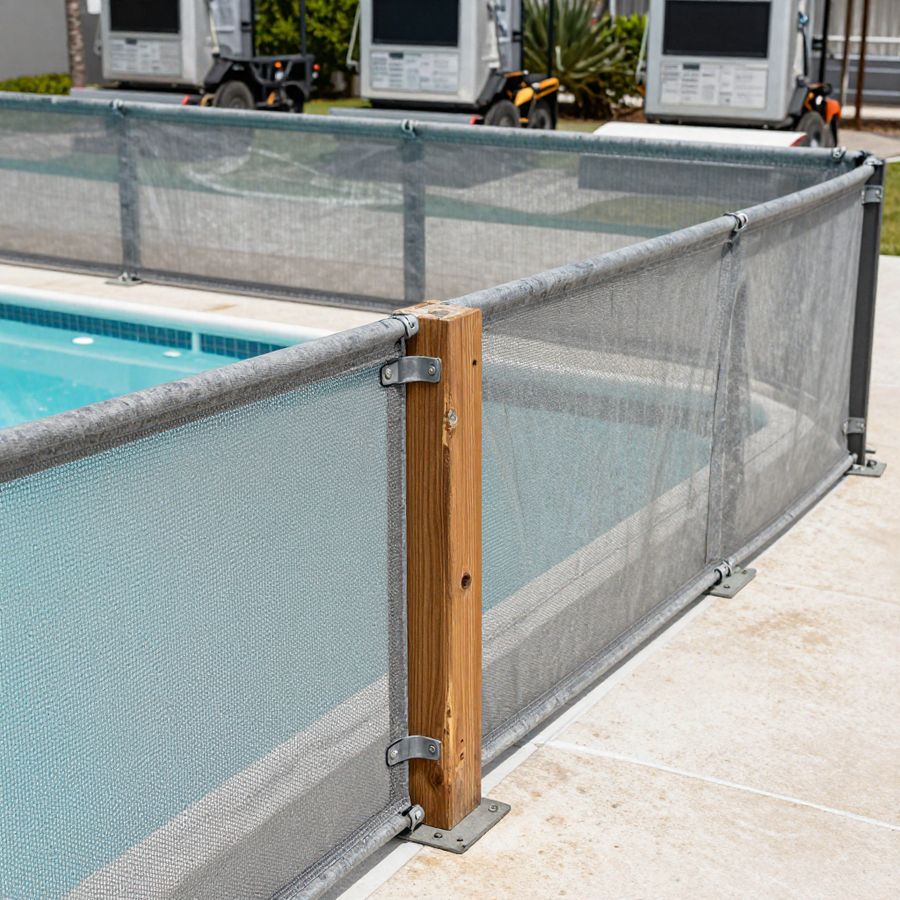
Mesh’s core advantage is real: it comes down in minutes for a pool party, a deck cleaning or a seasonal change, then rolls up and stores until needed again. Panels can be reconfigured with new sleeve holes if the layout changes, and mesh can enclose stairways, columns or other openings beyond the main perimeter, which a rigid barrier often can’t do as easily. One installation limit belongs here without turning this into a code page: mesh cannot go on top of an above-ground or on-ground pool at all, a compliance question covered where the rest of Florida’s barrier law lives, not here.
Here’s the same fact from the other side, and it’s the whole risk in one sentence: a mesh barrier only protects while it’s actually installed. The recurring pattern: a section comes down for a pool-service visit, a party or a repair, and it doesn’t go back up, while the household keeps believing they have a barrier because they own one.
Routine pool service is a systematic barrier-opening event, not an occasional one - the technician needs access on a schedule that rarely lines up with the family being home to supervise the reinstall. Build an explicit protocol with your service provider if you go the mesh route, and a way to actually verify the barrier went back up correctly, not just trust that it did.
Permanent is the mirror image: fixed for the life of the installation, with none of that reinstall risk, but taking it down later, especially a glass system, is real disassembly work.
The view, and the sellers who disagree with themselves
This is the section I’d point a skeptical buyer to first. Mesh gets marketed, consistently, as giving a fully open, unobstructed view of the pool. Fair enough, except that at least one of those same sellers has a separate page on its own site admitting the mesh weave “still obstructs the view of the pool” and “ruins the aesthetics” when compared directly against glass. That’s not two different companies disagreeing. That’s one source contradicting itself across two of its own pages.
The honest reading isn’t that either claim is a lie. It’s that visibility depends heavily on what you’re comparing mesh against. Set it next to a solid privacy fence and mesh looks wide open. Set it next to glass and the same weave reads as an obstruction. Both statements can be true at once, and that’s exactly why I’d treat any unqualified “unobstructed view” claim with some suspicion going forward.
On the permanent side, the sub-option matters again. Aluminum ornamental is itself fairly open by design, and its sightline character sits close to mesh’s. Glass is the clearest option in this whole comparison, no real competition there. A solid privacy fence, whether vinyl or wood, blocks the view entirely, which some owners want and others are specifically trying to avoid.
How long does mesh last? Nobody independent has said
Here’s the most useful finding in this comparison, and it isn’t a number. Three separate search routes tried to find an independent figure for how long mesh fabric lasts: a general search, a search restricted to sites like cpsc.gov, .edu domains, consumerreports.org, nih.gov and ufl.edu, and a further search restricted to the Consumer Product Safety Commission, PoolSafely, NFPA and NIST. All three, run as of July 2026, returned zero non-vendor sources of any kind.
Every figure circulating online, whether a claim of 5-10 years, 15-20 years, a “100-year warranty,” or flatly “lifetime,” originates with a company selling the product, and those claims contradict each other by a factor of four, sometimes on the same seller’s own pages. Averaging them into something authoritative-sounding would just be inventing a figure nobody has established. The honest answer to “how long does mesh last” is that nobody independent has said, as of this writing.
The sellers don’t agree with each other on durability more broadly, either. Some describe the poles and mesh as strong and long-lasting. Others, including a rival seller and a second article from the very seller making the first claim, describe the fabric as less durable than glass, metal or wood, deteriorating like plastic, and needing more frequent repair.
Permanent aluminum inherits the permanent option’s own service-life profile, stated once: claimed at 30-50+ years for a properly finished system, hedged there already, so I won’t restate it. One durability requirement does carry legal weight, and it belongs to the compliance cluster, not here: the code requires compliance with a named standard and installation per the manufacturer’s instructions, a legal question that lives on the pages covering Florida’s barrier law.
Daily life with each one
Living with either barrier day to day looks different depending on which one you picked. Mesh needs a tension and latch check every single time it’s reinstalled, and that’s a per-use task tied to whatever just happened, not something you pencil into a calendar. Gates on mesh systems aren’t always self-latching either, which at least one source frames as a real weakness rather than a minor inconvenience. Permanent needs periodic, calendar-based inspection instead, since it’s never taken down in the first place and there’s no reinstall step to get wrong.
There are two safety framings out there, and both come from sellers with an obvious stake in the answer, so I’m crediting neither one uncritically. The pro-mesh argument says the non-climbable woven design eliminates footholds, and that removability is a genuine feature for households that reliably reinstall and latch it correctly. The pro-permanent counterargument is just as real and just as sourced: a fixed barrier removes the daily human judgment call entirely, and rigid materials can still be climbed by an active, determined child, which can create a false sense of security if a household assumes “permanent” automatically means “unclimbable.”
On installation impact, mesh means small sleeve holes drilled into the deck with no major digging involved. Permanent means more construction-intensive work, post footings, and in some cases permitting on top of that. On aesthetics, mesh is generally seen as less visually premium; permanent, especially glass, gets credited with adding property value as a fixed architectural feature.
For whom each one wins
Before the verdict, the same reminder from the top of this page: this decision sits downstream of a compliance question this page does not answer, so settle that first.
Mesh wins for households that genuinely need flexibility - frequent entertaining, a rental property, an upcoming renovation, or a need to enclose stairways and equipment openings along with the main perimeter. That’s a real use case, not a lesser one. It comes with a condition worth stating plainly, though: mesh’s safety value depends entirely on the household reliably reinstalling and latching it correctly, every time, because that value isn’t structurally guaranteed the way a fixed barrier’s is.
Permanent wins for households who want no daily judgment calls at all, the lowest long-term maintenance, and a barrier that doubles as a yard boundary or a curb-appeal feature in its own right. The trade-off is a higher upfront cost and far less flexibility once it’s in the ground, and there’s no price figure attached to either side of this comparison to weigh against that trade-off directly.
I’ll close on the skepticism point, because it matters more here than anywhere else in this hub: read marketing claims on both sides more skeptically than you would elsewhere on this site. This research found mesh sellers contradicting themselves on their own pages, on both view and durability, and that’s reason enough to take any confident claim from either side with a grain of salt.
Frequently asked questions
Is removable mesh as safe as a permanent barrier? It depends on one condition: mesh only holds its safety value if it’s reinstalled and latched correctly every time, while a permanent barrier removes that daily judgment call. Neither answer is the legal one - that lives on the compliance page linked above - and permanent isn’t automatically foolproof either, since rigid materials can still be climbed by a determined child.
How long does a mesh pool fence last? Nobody independent has published a figure. Three search routes, including one restricted to sites like the CPSC and PoolSafely, turned up zero non-vendor sources; the numbers in circulation (5-10 years, 15-20 years, “100-year warranty,” “lifetime”) all trace to sellers and vary by a factor of four. What you can check yourself instead: tension, sleeve caps, the bottom edge and the gate latch.
Does mesh really give a better view? It depends what it’s compared against. One mesh seller’s own marketing claims a fully open view, while a separate page on that same seller’s site admits the weave obstructs the view against glass. Against a solid privacy fence, mesh does look wide open; against glass, it doesn’t.
How much upkeep does each need? Mesh needs a tension and latch check every time it’s reinstalled, a per-use task rather than a calendar one. Permanent needs periodic, calendar-based inspection instead. Worth noting: mesh gates aren’t always self-latching, a real weakness rather than a footnote.
Does either one still have to meet Florida’s pool law? Yes, and this page doesn’t answer that question. Settle it first, on the page linked at the top of this article, before choosing a product based on anything below it.
Settle the compliance question first, then choose the product. Read both sets of marketing, mesh and permanent alike, with the same suspicion; this research found sellers on both sides contradicting themselves, not just each other. If you already have a barrier in the ground and it failed a check, see if you already have a barrier and it failed a check rather than starting this comparison over from scratch.
Sources
| Claim | Source | As of |
|---|---|---|
| Removability, sightlines, durability, upkeep, safety framings, aesthetics, installation impact | Commercial sources, in several cases the seller of the product being praised; self-contradictions reported rather than resolved | 2026 |
| The absence of any independent mesh service life | Three targeted search routes, zero non-vendor sources found | Searched July 28, 2026 |
| Permanent aluminum service life | Inherited by reference from vinyl vs. aluminum; commercial, claimed 30-50+ years, hedged there | July 2026 |
| Price | None exists for this pair | - |
Page last reviewed July 28, 2026.
This site is an independent guide to fencing in the Tampa Bay area. It does not install fences, employ crews, sell materials, hold a contractor’s license or accept referral fees from anyone in the trade, and nothing above is a substitute for confirming your own compliance with Florida’s pool-safety law, or for supervision around water.
Reviewed by Dana Whitfield, CGC, certified building code inspector.


Code and permit claims reviewed by Dana Whitfield, CGC, certified building code inspector.
Florida-licensed general contractor, certified building code inspector. How we check facts: our sources and limits.
Read next
- Chain Link vs Vinyl: Cheapest Fence, and Its CatchWhat chain link saves, what it costs you in privacy and acceptance, why coated beats bare near the coast - and the two jurisdictions here that restrict it outright.
- Deferred-Interest Calculator: What It Costs If You MissEnter your own financing offer and see what deferred interest actually costs if a balance remains at the end of the promotional window - side by side with clearing it in time.
- Fence Cost Estimator for Tampa BayEstimate a fence in Hillsborough, Pinellas or Pasco by material, height, gates and terrain - with every rate shown, dated and sourced, and no email required.
Want a quote read by someone who has no stake in it?
We do not install fences. Tell us what you are planning and we pass the request to a licensed contractor who works your area.
Request a callback
Enter your number and we will call you back. Nothing else is required.
We do not install fences. Your request goes to a licensed contractor who works your area, and we may be compensated for the introduction.
Advertiser disclosure. This page can earn us money. If your request reaches a contractor through the form or the phone number above, we may be compensated for that introduction. It has never determined what any page on this site says, and no contractor has editorial input. We hold no contractor licence of our own and perform no work.